When a public figure posts something foolish, blasphemous, or beneath the dignity of their office, Christians who voted or support that figure in any way often face an immediate accusation: you are a hypocrite. How could you vote someone who doesn’t live up to your own faith?
The answer is simpler than the accusation assumes: Christians don’t require their political leaders to be Christians, or even moral exemplars in every way.
What Is Not Hypocritical
This is an observable pattern that goes back to Rome. The early church prayed for Caesar, submitted to governing authorities (Romans 13), and sought the welfare of cities in which they were strangers (Jeremiah 29:7). None of these things were done with the qualifier that their leaders share their faith or character.
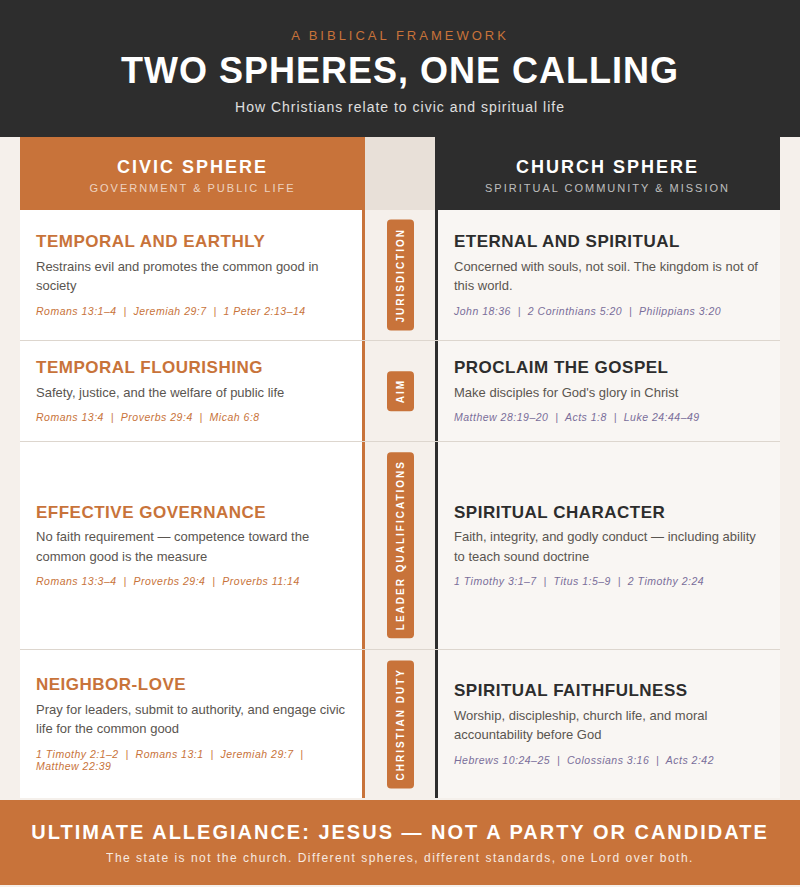
The reason is straightforward: civic life and church life operate in different spheres, have different qualifications for leadership, and have different aims. The state is not the church so we relate to her differently. We rightly require our pastors to meet high spiritual qualifications (1 Timothy 3, Titus 1), but we require no such thing of our mayors, senators, or presidents. The church’s mission is to proclaim the gospel of Jesus to make and grow disciples (Matthew 28:18-20). The government’s mission is not the salvation of souls but the ordering of society. As Paul says in Romans 13, to restrain evil and promote the common good. These are different goals, held by different kinds of institutions, accountable to different standards. A leader can fulfill the aims of civil office without being a Christian.
The distinction is not complicated. The chart below fleshes out the two spheres (civic and spiritual) across four categories: their jurisdiction, their aim, the qualifications they require of leaders, and the duties they call Christians to fulfill.
Surely, Christians ought to prefer leaders of integrity and principle. Where competence exists, character and faith only strengthen it. But preference is not requirement.
Given the reality of these two distinct spheres, the question for a Christian at the ballot box is not, Is this person morally worthy of my approval? but, Whichcandidate will govern best toward the common good? That is a policy question where there is a lot of room for disagreement amongst believers. A Christian’s vote isn’t about spiritual faithfulness within the church, but neighbor-love for the nation.
That said, it is worth noting that the range of legitimate Christian political disagreement has limits. While there is real liberty in how Christians weigh competing policy priorities, some platforms move far enough from basic Christian beliefs and values that supporting them requires increasingly significant theological compromise. Without turning this into a separate post, I will simply say that the current Democratic platform has, in my view, drifted into that territory in ways that make enthusiastic Christian support difficult to reconcile with historic Christian teaching. But that asymmetry does not change the basic question every Christian voter must still answer. Casting a vote is not a full character endorsement nor a baptism. It is an imperfect attempt to love the people around you by supporting whomever you believe will serve them best.
This means a Christian can vote for a candidate and still condemn that candidate’s sin without being hypocritical. These two things are not in tension. They never were. The vote is about policy and governance. The condemnation is about moral accountability. Both are Christian responsibilities.
That said, the hypocrisy charge doesn’t disappear entirely. It just belongs somewhere else.
What Is Hypocritical
There are two kinds of people who stand on completely different sides of the political aisle, but are mirror images of each other. The first defends everything their preferred leader does and refuses to condemn any wrong. The second condemns everything the opposing leader does while never acknowledging any good. Both trade eternal principles for temporal team jerseys. Both let political identity become the standard by which they judge.
The consistent Christian position is neither. For those we support and don’t support, Christians must be willing to call out wrong when wrong occurs. For those we reject, we must refuse the impulse to reduce that person entirely to their worst moments or best ones. As lovers of the truth, Christians must grow in their skill and practice of calling balls and strikes. This isn’t easy. It requires courage, intellectual honesty, nuanced moral reasoning, and theological maturity that goes beyond Bible verses painted on coffee mugs. Sadly, in the absence of those things many people opt for reactive, mindless partisanship instead.
Some Questions for the One in the Mirror
It is not difficult to critique a leader you did not vote for. The real test is whether you will critique the leaders you did support. I was encouraged to see that, after President Trump’s latest foible, many of those who voted for or supported him publicly condemned his recent post passed that test. The question worth asking is whether people, Christians especially, on the other side of the aisle will apply the same standard to their own preferred figures when the moment comes.
Here are three diagnostic questions worth asking yourself:
When a candidate I oppose does something genuinely good, am I willing to say so? If the honest answer is no, or if the question feels uncomfortable, that is a sign that political identity has outpaced moral integrity.
When a candidate I support does something wrong, am I willing to name it clearly?Not just privately, not only with excessive qualification, but with the same directness I would apply to someone on the other side. If the standard shifts depending on who is doing the wrong, do you even have a standard?
Do I hold my preferred leaders to the same measure I apply to those I oppose?Consistency does not mean treating every failure as equally serious. It means the framework does not change based on the jersey.
These questions are not best asked to others, but to the one in the mirror. The only political tribalism we have the power to heal is our own, so start there. As believers, our ultimate allegiance is never to a party or a candidate, but to Jesus.
Consistency is not complicated, but it sure is countercultural. With such a divided day, it might be one of the clearest witnesses a Christian can offer.
I dated my wife for six years before we got married. We met in high school. For those years, I was very much in love, but also was very broke and very jobless. Since husbands are providers, I couldn’t sign up for that responsibility until I had an income. Eventually, thank God, I got there. My only frustration is I couldn’t marry her earlier.
Professionally, I’ve taught and worked with high schoolers and college students as both a teacher and a professor for over 20 years now. I have watched a lot of young people get the love bug and experience a lot joy, beauty, and good and others a lot of pain, confusion, and heartbreak. With two decades of front-row seats, I’ve developed some opinions.
Nobody asked, but I am giving them anyway. The following are seven pieces of unsolicited dating advice that could ensure a lot of good and help avoid a lot of bad.
1. Don’t Date Non-Believers
Why would you go on a road trip with someone who is heading to a completely different destination? Dating isn’t just hanging out, but taking a journey toward a potential destination called marriage, family, and a shared life. If Jesus Christ is the center of your life, the Sun whom all other planets in your life revolve, and the person you’re dating doesn’t worship him too, you are not on the same road. Heck, you’re not even sharing the same universe. You might enjoy the ride for a while, but eventually the GPS is going to ask you to make a turn that only one of you wants to take.
This isn’t saying that non-believers are terrible or inferior in value. It’s simply acknowledging they, by definition, serve another god. Jesus doesn’t play nice with false gods so, in love for Him, believers shouldn’t date those who love them.
If you want to road trip to Canada, don’t jump in the car with someone heading to Mexico (2 Corinthians 6:14-16).
2. See Dating as a Road, Not a Destination
Nobody camps on the freeway. The freeway is not a destination, but how you get to a destination. Dating works the same way. A lot of students treat dating like a status, a category, or a social achievement. “I have a boyfriend” or “I have a girlfriend” becomes the whole goal. Once they reached it, they just stay there. Indefinitely. They’ve foolishly believed being in a relationship is itself arriving.
It is helpful to not see dating, therefore, as a status, but an activity; as something you do to gain clarity about someone. Your goal in dating should not be companionship for its own sake, but something you do to figure out: is this the person I can confidently give my life to? Do we worship the same God? Do we have the same values? Is this someone I want my future daughters or sons to be like? Have I seen enough of their character to know what kind of person they are and want to become? Seeing dating not as a relationship, but an activity toward a potential relationship (i.e. marriage) will sharpen your focus, guide your actions, and make you hungry to not merely feel nice, but to learn crucial truth about the person with whom marriage is a possibility. It turns a relationship from a cul de sac to a highway that’s going somewhere.
3. Character > Rizz
For the uncool adults: “rizz” is what young people currently call charm or charisma. The magic that makes people melt for you. Rizz is fun. Who doesn’t want to be charming or be with a charming person? I get it. But rizz fades. Rizz does not take out the trash. Rizz does not sit with you in the hospital. Rizz does not apologize well or show up consistently or love you when you’re not at your best.
Rizz is fine and good, but not the goodest.
When it comes to dating, getting your priorities right matters more than most people realize. Before you pursue anyone, make two lists: principles and preferences. Preferences are optional. Principles are not. Know your preferences, but never let them crowd out your demands for principles.
How attractive someone is, how tall they are, how effortlessly cool they seem: none of those things compare to the character of the person you’re actually dating. Before you ask “Are they cute?” ask “Are they kind? Are they honest? Are they someone people trust?” You can enjoy rizz, but you’ll have to live with character. Evaluate accordingly.
4. Good Relationships Make Gooder Relationships
One of the most telling signs of a healthy relationship is what it does to the rest of your life. A good dating partner should make you better, your relationships with others included. They should make you better to your friends, more present with your family, more focused on fulfilling your responsibilities to those God has already entrusted you. Your “special friend” (lol) should enrich your other relationships, not drain them. They should serve as an add, not a subtraction.
If your friendships are suffering, your family is worried, your grades are slipping, and your whole world has contracted down your dating partner, that’s not romance but a warning sign. Your sweet honeybear should be a positive, not a parasite. True love builds. It doesn’t destroy.
5. Be Who You Want to Attract
The bait you use determines the fish you catch.
A lot of young people spend time asking: “Why can’t I find someone good?” But the more useful question is: “What kind of person am I attracting and why?” How you dress, how you speak, how you act, what you post, what you laugh at, what you prioritize are all sending a signal. Are those signals attracting the kind of person you actually want? Or are they attracting people you’ll later wish you’d never met?
If you want to date someone of who loves Jesus, has wise habits, healthy goals, and good character, then strive to become a person just like that. Like attracts like. Be the person you’re looking for. Running as fast as you can toward Christ will attract others who are doing the same.
6. Listen to Your Community
Infatuation is a heck of a drug. I mean that sincerely. When you fall for someone, your heart and mind do genuinely strange things. Everything about them seems wonderful. You’ve a knee jerk reaction to paint any red flag green. “He’s not that bad, you just don’t know him like I do.” Every concern your friends or family raise is heard as jealousy, judgmentalism, or uninformed. When head over heels, you think down is up and live accordingly.
This is why your community — your family and church — matter so much. The people who love you and have known you longest can see things you cannot always see in the moment. Before that season arrives, you need to have already decided that you will listen to the people around you, especially when what they have to say is uncomfortable or inconvenient. Their perspective and honest feedback on your relationship is not a threat, but a gift.
Sometimes people’s counsel or perspectives can be wrong and its fine to reject it, but, as a simple rule of thumb to trust, if everyone who loves you shares the same concerns, take their unanimity with the utmost seriousness.
7. Don’t Kiss
Before you have a strong emotional reaction to this one, I want to ask you to do something: don’t let emotions do your thinking. Hear me out.
I’m not talking about a peck on the cheek like the one you can give grandma. I’m talking about making out, french kissing, extended physical intimacy. Any kind of kissing that is sexual in nature. In his scholarly article on making out (yes, this exists), Pastor Gerald Hiestand offers the simple argument:
Premise 1: All sexual activity must be reserved for the marriage relationship.
Premise 2: Some forms of kissing are sexual.
Conclusion: Therefore, sexual forms of kissing must be reserved for the marriage relationship.
You can read the article to see if you agree in the sexual nature of making out (though I wonder if you can think of a non-sexual form of making out). Regardless, the syllogism is worth some serious thinking. As Christians, we are called to not conform to the world but to be transformed by the renewing of our minds (Romans 12:1-2). By today’s sexual standards, making out is practically the same as holding hands. It may do us well to think before we smooch.
Deciding not to kiss in this way has a lot of practical wisdom to consider. Making out is not a finish line, it’s an on-ramp. It clouds your judgment when you need it most. It bonds you emotionally to someone in ways that have nothing to do with whether they’re actually right for you. Make sure someone loves your heart well before they touch your body. A person who respects that boundary is showing you something true about their character and their love for you. A person who keeps pushing against it is also showing you something true about their character and their (lack of) love for you. If you want to make sure someone loves you and not just what they get from you now, this is a pretty reliable test of someone’s character and intentions.
Now, if you’ve read this list and are now filled with shame, guilt, or regret because you got a few things backward, allow me to remind you: in Christ, you have been washed, sanctified, and justified from sins you’ve done or sins done against you (1 Corinthians 6:9-11). In Christ, you are a new creation and by the power of the Holy Spirit can live toward a different future. Rejoice anew in Christ’s grace and walk in the loving wisdom of his way from here on out.
Nobody has to take this advice. You never asked for it, anyways. But after six years of dating the woman I love and twenty-plus years of watching students navigate this season of life, I think these seven things can make a difference. Dating doesn’t have to be confusing or painful. With the right priorities and a little wisdom, it can actually be what it’s supposed to be: a purposeful, joyful road toward something wonderful.
A three-legged stool needs all three legs to stand. So the Christian life requires three legs to know the joy Christ has saved us for.
Learn the Word of God
Not packaged devotionals, but Scripture. Not neglecting, dipping into, or skimming, but studying. Not just the New, but the Old Testament. Not just the familiar, but the unfamiliar: Leviticus, Obadiah, Amos, Obadiah, and even Nahum. Not for vibes, but understanding unto obedience and worship. Not part, but the whole. Not just personal reading, but public teaching. Not only privately, but corporately. Words, grammar, context, meditation. Page after page. His Word is my soul’s food.
Lean on the People of God
The Church is family, so I am obligated to the Church. Christianity is a team sport, so I need the Church and they need me. The church is not an event but a family and that family holds a weekly Sunday reunion I make sure to attend. Jesus’ Church is the team, school, hospital, and family I cannot live without. Without her, I am like an orphan on the street. With her, I am a son, brother, and father with a family to be loved by and to love.
Love the Heart of God
I have been created by the Word of God, made in the image of God, saved by the Son of God, filled with the Spirit of God, and I hunger to be satisfied by the beauty of God alone. His creation is marvelous, but the satisfaction my soul craves is sold separately from it. My deepest desires are met, my most painful wounds are healed, and my greatest joy is supplied by simply knowing Him in Christ and making Him known to others.
Among the many good habits I’ve learned, these are my food, drink, and oxygen. Without them, I fall. With them, I stand with joy unsurpassed.
A father came to his dojo with his son for some quality time together. The boy had been in a season of rebellion. He was getting suspended from school and making life hard at home. The teacher didn’t lecture him, but wanted to teach him something valuable.
He had the boy’s father get down and start doing a few push ups on the floor. He pointed out, “Your dad is strong. He’s built for this.” After a couple, he told the boy to climb on his father’s back then told the dad to continue his pushups.
As the father began to push under the weight of his son, he slowed. Straining, shaking, and sweating, he kept going.
As the father struggled under the extra burden, the teacher looked at the boy in the eye and quietly spoke to him:
“He works. He provides. He carries all of it. And you’re making it harder because you’re only thinking about yourself. This is what he does for you. But he can only do so much. It’s crushing him.”
Then he told the boy to put his hands on the floor and push up with his dad. He stopped being dead weight and started to help carry the load. With help, the push-up was easier. Without it, the father was near collapse.
I have thought about that lesson a hundred times. It illustrates an important reality: many men are quietly struggling under massive weight that’s regularly unseen or unknown, even by those closest to them.
Being a husband and father is a joyful privilege. It is also a heavy responsibility. Both are true at the same time. Men wouldn’t trade it for anything, but that doesn’t mean they don’t need help.
They do.
A Mirror and a Window
The karate teacher’s lesson is focused on fatherhood. I’d like to focus in on marriage. As I do, I write with two readers in mind: husbands and wives.
For husbands, I hope to offer a mirror to help you see your own experience and feel a little less alone. You’re not strange or weak for feeling straining under the weight and the need for your wife’s help. She is created to be your suitable helper (Gen. 2:18), after all.
For wives, I offer a window to give you a clearer view of the hidden burdens and needs of the man you married. Rest assured, I’ve no axe to grind. Nor do I aim to guilt or blame you. This is not a justification, an accusation, or a diatribe to add into the everlasting gender war. I just want to help you see the man you married more clearly that you may love and help him more wisely. As a wife, you’ve been entrusted incredible power as a helper to, well, help.
Marriage is a union of two very different image bearers: one man and one woman. When they better understand their own and each other’s unique needs, along with their own unique power to fill those needs, greater joy and flourishing will result.
The Hidden Needs of Husbands
God needs nothing. Humans need a lot. Husbands are not generally needy creatures, but they absolutely have needs. They’re usually quiet about them. They’re not sure they’re allowed to voice them. Some men feel them, but can’t identify them. Others have voiced them and were mocked, blamed, or pushed away for it. So, they put their heads down and grind on a bit slower, much quieter, and with a lot less joy. The needs of husbands aren’t talked about a lot, but they’re real and they matter.
1. A husband needs to be loved for who he is, not what he does
A lot of men learn a lesson early on in life: your value is based on your output. By word, deed, or unspoken expectation, they perceive their income, their productivity, their ability to provide and protect determines their worth. I think this is why a man’s job or handiness so easily become central to his identity. Not necessarily because he’s greedy or because he loves working on things, but because he wants to feel valuable. If he’s only thought about when something needs fixing, dirtier chores need doing, money needs to be dispersed, or stuck pickle jars need opening, he might begin wondering, “Is this all I am?” If his job disappeared, if the income dried up, if his strength gave out, he wonders, “Would I still be loved?” A man deeply desires to know he is loved, not for what he does, but for who he is.
2. A husband needs a home that is a sanctuary, not a battlefield
In one of the more humorous sections of the Bible, we read:
“Better is a dry morsel with quiet than a house full of feasting with strife.” (Proverbs 17:1)
“Better to live on a corner of the roof than share a house with a quarrelsome wife” (Proverbs 21:9)
“A quarrelsome wife is like the dripping of a leaky roof in a rainstorm” (Proverbs 27:15).
At first, these verses make you laugh. If you linger long enough, they make you think. A man who spends his days fighting battles, navigating conflict, feeling increasing pressures, and taking on the relentless demands of the world outside his front door has a deep need for his home to be something different. Not perfect. Not silent. Not luxurious. Peaceful. No soldier can fight a war on two fronts very well or, at least, for very long. The best of athletes need a place to rest after competition. Men need their homes and marriages to be the one place where they’re invited to put the sword away, take off the armor, and let the shoulders come down.
It shouldn’t shock us, therefore, if men with contentious homes end up spending a lot of time at a favored third place between work and home — a bar, cigar lounge, golf course, bowling alley, etc. That’s not good, but it is revealing. These men have a deep need for rest they’re not finding at home. It doesn’t mean men shouldn’t have responsibilities at home. It does mean that home should have rest for men. When home becomes yet another battleground, men lose something deeply needed.
This is where you, dear sisters, have great power. You are equipped by God to be a one-of-a-kind source of rest and refreshment for your husbands. You have the rejuvenating power of ten-thousand vacations. You, therefore, have an important question to ask yourself: will I make our home another battleground for him to fight on or the one place he can find the rest he needs? Will I be his special garden (Song of Solomon 4:12) or another desert?
3. A husband needs to know he is not failing, but fulfilling his role
I’ve wondered if, in our effort to fight against the abuse of women, we’ve created a culture that abuses men. I could be wrong. I don’t think I am. There is a weird double-standard in how we speak, think about, and treat men and women. I once heard it expressed like this:
“When culture addresses women’s struggles, the question tends to be, ‘How can society do better for them?’ When it addresses men’s struggles, the question tends to be, ‘How can men do better?’”
When women are hurting, they’re victim. When men are hurting, they’re responsible. Two different measuring sticks for two different genders.
Unfortunately, the church doesn’t seem immune to thinking this either. You may not have experienced this, but it isn’t uncommon for the sermons on Mother’s Day and Father’s Day to be very different in focus and tone. On Mother’s Day, mothers’ sacrifices are highlighted, their essential role celebrated, and extraordinary amounts of praise are rightly given them. On Father’s Days, fathers are mocked or chastised to level up (and especially do the dishes). We’ve a culture quick to praise women (which is wonderful), but mock men (which is not).
In these cultural waters, husbands are hungry to know one thing: you don’t suck and you’re doing good. Men don’t need flattery or trophies or exaggerated praise, but they do need “gracious words like a honeycomb” that are “sweetness to the soul and health to the body” (Proverbs 16:24). When a wife ensures her criticisms or complaints are eclipsed by her affirmations, a husband will come alive. A wife’s specific, frequent, and genuine expressions of gratitude like, “Thank you for loving us so well” or “I appreciate how hard you work for our family” or “I am proud to call you my husband” or “You are an excellent father and husband” will nourish her husband’s soul. A wife’s gratitude and appreciation is her husband’s food.
Sisters, your husband needs to know he’s not quietly ruining the lives of those he loves the most. He needs to know he’s not failing, but fulfilling his role. He needs to hear from you, “You are a good man.” Not because he’s weak, but because he’s a human living in a world that’s especially, and sometimes unfairly, hard on him. If you want your husband to be a good man, make a practice of telling him that whenever he acts like one. You’ll see him stand a little taller each time you do.
4. A husband needs to feel liked by his wife, not merely tolerated
Most men are surprisingly comfortable being misunderstood or underappreciated by people in the world. It comes with the territory of building, leading, and doing hard work in the world that not everyone sees, recognizes, or appreciates. He’s likely developed thick skin for the haters in the wild. What they can’t absorb so easily is the feeling that their own wife does not particularly like them. Men have no defense for the cold detachment of an unaffectionate wife. It cuts deeper than anything else can.
Men don’t desire to be dutifully loved, but genuinely wanted by the woman they married. They don’t care what others feel about them. They care the world for how their wife feels about them. They recognize this affection not so much by a clean house or a home cooked meal, as meaningful as those things are. They do see it through what only a wife can offer: physical affection. A hand held. Fingers through hair. A snuggle. A kiss that isn’t purely functional. Enthusiastic initiation and participation in marital intimacy. These small gestures carry the one message men need to hear from their wives: “I see you. I love you. I actually like you.” Without them, a husband begins feeling more like a roommate or, worse, a burden and he’ll be tempted to detach, close up, and go silent. Not because he’s passive aggressive or immature or mean. But because he feels like a burden to his wife and his dignity keeps him from begging for scraps of the marital affection from her he desires.
Maybe a simple picture can help you, wives, see your power. The touch of Jesus had the power to heal leprosy, give sight to the blind, and even raise the dead. To your husband, your affectionate touch carries a similar power. Wield it often.
5. A husband needs his helper, not another burden
Genesis tells us that Eve was created as a suitable helper for Adam (Gen. 2:18). Contrary to modern sensibilities, this is not a demotion or denigration of women. It is a profound calling. It implies women have a one-of-a-kind, powerful, and necessary strength that their husbands genuinely need. You are the milk to his cookies, the ying to his yang. God has not designed husbands to lead their homes alone, but blessed man with a gloriously good, well-equipped, and necessary helper in his wife. God has created and entrusted wives with an irreplaceable superpower their husbands need.
And, as leaders of the home, husbands definitely need their helper.
Leadership, in Scripture, is not a reward. It is a terribly heavy blessing. It doesn’t just mean he’s in charge, but that he’s ultimately accountable for everything under his roof. He feels this constantly, deep in his bones. Like Damocles’ sword, the burden of the bills, the mortgage, the income, the kids, the marriage, and the overall well-being of the family hangs above his head at every moment. So, if a wife unknowingly slips into habitually complaining, criticizing, or creating ever-increasing honey-do lists with strict due dates, a husband will receive it as more weight to carry. Those things matter to a good husband and he’ll take them seriously. But, when a wife forgets her role as helper and slips into another boss, then he’s doomed to carry all the weight alone. He may not mention it. He may not even fully know it himself. But he’ll feel it and pressure-cracks will start to show.
Wives, may I ask, how are you using your power and position as Helper? Ask, “Am I working to cheerfully help my husband or have I unintentionally become another burden he has to carry?” Are you easing his weight or adding to it? Even more, consider, are you helping your husband in the wayhe needs youto or merely in a general way that makes sense to you or is most convenient? Remember, you are his suitable helper, not just a general helper. There are ways you may like to help him, but there are also ways he needs you to help him, ways that are meaningful and needed by him. Without your help, he’ll likely press on, but deflate to half the man he is. With your steadfast, wifely help, your husband will slay dragons and laugh deep from the belly while doing it.
Brothers, regardless of what you feel, please hear this: dudes rule. If you’re reading this, you’re likely not a the idiot, slob, or burden you fear. You’re made in the image of a holy God and bought by the blood of His precious son. As a sanctified man, you are “the glory of God” (1 Cor. 11:7). Keep shouldering the weight. Don’t quit. Too much good depends on your faithfulness. Onward and upward.
Sisters, your husband is not needy (hopefully), but he does have needs. Thankfully, by God’s grace, God has given him you as his Helper. Arise and take up your post. Be for your man what only you can be.
Brothers and sisters wed in marriage, for the joy of your souls, the good of your family and neighbors, and the glory of God, take up your role and fulfill it with all the strength he gives you.
Marriage is widely treated as a merely religious institution, defended by believers and dismissed by everyone else as a sectarian preference.
The following is a fictional conversation between two high school juniors about marriage. It is based on a real conversation I had with my own Bible class this week. You’ll notice, no Bible is opened for the vast majority of the conversation. No argument from religious authority is made.
What they arrive at together, through nothing but careful thinking, is that marriage is not a doctrine belonging to religion alone, but a discovery about something built into the very fabric of human nature and society.
It Was Soup Day
Mr. Dill’s classroom was carpeted, with one big oval table where all sixteen students sat together. The students who saw Bible class as a waste of time and strongly believed it should be an easy “A” did not like this set-up. It made it hard to zone out. Eye contact was basically unavoidable. Messing around was nearly impossible. Mr. Dill, a teacher who loved learning and detested the mere appearance of it, liked it that way.
He’d just finished walking his junior theology class through the Christian doctrine of marriage. The room had that particular quiet that meant either nobody cared or everybody was processing. Mr. Dill never knew which one it was. Hard to tell with high schoolers.
The bell rang and the students started packing up with peculiar speed. Lunch time had begun. Knowing it was soup day and Chef Baird’s specialty was hot and ready, time was of the essence.
A Courageous Question
Abel, a skinny boy with one of those haircuts that looks like a bird’s nest was tightly glued on his head, tossed his notebook into his bag. He looked to his friend next to him at the table, Ethan, a friendly football player and no-too-bad guitarist. He too was packing his things like there was a fire. Making sure Mr. Dill couldn’t hear, he whispered.
ABEL. Okay so that was kind of a lot.
ETHAN. What do you mean?
ABEL. Mr. Dill. His whole thing. Like, I get that he has his view, but he basically just said gay marriage isn’t real marriage. That’s kind of a big claim to just lay out like that. A little extra.
ETHAN. Interesting. I take it you think gay marriage is a good thing?
Abel blinked. Ethan can be a bit too traditional and overly religious in his view. He’d been expecting push back, but not a question. Annoying.
ABEL. I mean, yea, because, like, people should be able to love whoever they love. That’s just basic. Love is love. What kind of psycho would be against love?
ETHAN. Okay. Do you think Mr. Dill hates love?
ABEL. Well, no. I wouldn’t say it like that. But, given what he just laid out, he wants to limit love only to the special folks he and his book allows. He discriminates. “Marriage for me, but not for thee” kind of vibes.
ETHAN. Hm.
Abel opened his mouth. Closed it. He thought Ethan was cool, but now he was considering he may be wrong. Is Ethan homophobic?
Definitions Matter
ETHAN. I got a burning question. Is a blorg good or bad?
ABEL. What’s a blorg?
ETHAN. Don’t respond with a question. Answer my question first. Is a blorg good or bad?
ABEL. What’s a…
ETHAN. I said you had to answ….
ABEL. I don’t know what a blorg is! I can’t say if it’s good or bad unless I know what the heck it is!
ETHAN. That’s the point.
ABEL. You’re so weird and frustrating.
Ethan laughed and threw his arm around his friend.
ETHAN. My point is, you can’t evaluate something you haven’t defined. You called Mr. Dill’s view too narrow, but compared to what? You need a definition before you can say whether something is or isn’t that thing. Before anyone can say gay marriage is good or bad, right or wrong, what do we have to do first?
ABEL. … Define marriage?
How Are Babies Made?
ETHAN. My guy! So, what is the only way a child can be made?
ABEL. Dude, we’re juniors. Even if we’ve lived under a rock until now, we covered this in Dr. Gaunt’s anatomy class. A guy and a girl.
ETHAN. Right. A man and a woman is the only relationship that has the power to reproduce. That’s not Bible, that’s just biology.
ABEL. I thought we were defining marriage. Why are we talking biology and not opening dictionary.com?
ETHAN. This is more fun. And if we take out our phones Dr. Pinto will appear from no where an slam us because of the no-phone policy. We’re getting there, so chill. So, back to biology. Should society care about kids being born?
ABEL. Yeah. Mrs. Simons was literally just talking about this. Like the greying generation thing, how there aren’t enough young people coming up to support all the old people. Social security, healthcare, production, services and all of that. Society kind of needs lots of babies or the whole thing starts breaking down.
ETHAN. Wow, you listened to Simons? Cookie for you.
Abel socked Ethan in the arm.
ABEL. Shut up.
What Does a Kid Need?
ETHAN. But births aren’t the only thing needed to keep things rolling in society. The kids have to be taken care of, right?
Ethan laughed.
ABEL. Duh. If they aren’t then they take more resources from other members of society. Also, if they’re not raised well they’ll have a harder time getting educated, jobs, and maybe even get into some trouble.
ETHAN. Totally, so if a guy and a girl have a kid, we should want to do everything we can to make sure those kids don’t rot, but actually flourish.
ABEL. Yep.
ETHAN. Ok, so what kind of home life does that best?
ABEL. Easy, two stable parents to balance the time, energy, and resources needed to care for the kids.
ETHAN. Are a mom and a dad interchangeable? Like, does it not matter which?
ABEL. I think what matters is that the parents are loving. Gender doesn’t really change that.
ETHAN. Love is definitely important and necessary, but that doesn’t answer the question. Are dads and moms different? If a kid is motherless or fatherless, is that unimportant?
ABEL.(slower) … I wouldn’t say it like that.
ETHAN. The data on father absence is pretty rough. Higher crime, more kids in prison, more behavioral problems.
ABEL. Ok, let’s say a kid has two dads. Problem fixed. If fathers are so important, maybe even better?
ETHAN. Ouch to the ladies, bro. So, you think women are unimportant?
ABEL. You know that’s not what I meant.
ETHAN. So you think moms and dads are important for kids? Like, we shouldn’t intentionally make kids fatherless or motherless?
ABEL. Yes, motherlessness or fatherlessness are bummers. They shouldn’t be plans.
ETHAN. I agree. Moms and a dads aren’t just two interchangeable parts. They bring different things to the table. That’s not a religious take, that’s the data and, like, fifteen seconds of human experience.
Abel agreed and it annoyed him.
ETHAN. So, only a man and woman can make a baby and the best care for the baby is to be raised by his mom and dad. Right?
ABEL. Yes.
ETHAN. Should the mom and dad’s relationship be permanent or just long-lasting?
ABEL. Permanent, I guess. A commitment that might end isn’t really stable. If one of the parents bail, no matter the kids age, it definitely wouldn’t be a plus.
More the Merrier?
ETHAN. Agreed. Now, why two parents instead of three or four or more? More parents, more contribution, right?
ABEL. Like a commune situation where all the adults are parents? Cult vibes. Or like the “thruples” — a three person relationship. I saw one of those on TikTok! Weird, but not sure if that’s a bad thing. What do you think?
ETHAN. Well, a good relationship is about mutual self-giving. A third or fourth person brought into a relationship doesn’t add to that, it divides it. Think about polygamy. Do you think Solomon was the best husband to all 700 of his wives? Or, did you know Bob Marley, the musician, had 11 children with 7 different women?
ABEL. So much for “one love”!
They laughed.
ETHAN. My point is, do you think Solomon or Bob gave their wives and kids the best of their time, love, and attention and treated them all equally?
ABEL. No possible way. Even if the kids and partners got equal time and energy, it would be sliced into such thin pieces that they’d be familiar strangers at best. I see your point, more love — in terms of parents and kids in the family — is actually less love. Not ideal.
ETHAN. I think I agree. I think each kid needs a mom and dad who are ride-or-die till death and that relationship needs to be exclusive. No open enrollment. Now, are any of those realities religious?
ABEL. Nope. No Bible verses or spiritual stuff to be found.
Discovering a Definition
ETHAN. Exactly. So far, this is what we’ve agreed on. Only a man and woman can make a baby.
ABEL. Again, duh.
ETHAN. And the best care for that baby is the mom and dad committing to a permanent, monogamous, and exclusive relationship.
ABEL. Yea.
ETHAN. Ok, so we should have a name for this unique and important relationship between a man and woman since there is no other relationship like it?
ABEL. Yea, unique names are given to unique things.
ETHAN. What should we call that?
ABEL.(quietly) Marriage.
Ethan smiled and laughed.
Ethan Sides With the Devil, for a Moment
ETHAN. Let me be an advocate for the devil real quick. I don’t usually like helping him, but let’s get wild.
ABEL. Proceed, Satan’s little helper.
ETHAN. What about a man and woman who get married but can’t have kids? Infertility is real. Does that mean their marriage isn’t a real marriage?
ABEL. I mean… no. That feels wrong to say.
ETHAN. Why?
ABEL. Because they are committed to and have the only kind of relationship that can produce and best raise children. All the pieces are there, it’s just that something isn’t working as it should. Like, the ability is built into what they are together, something is just broken. The infertile man and woman are like my car. It has a broken engine, but it is still a car.
ETHAN. That’s solid. Broken cars are still cars. A bike with a flat tire can’t be used to its fullest, but it is still a bike. The definition of marriage is about the kind of relationship they have. Even though the reproduction part is broken, it doesn’t erase the relationship itself as long as it has the basics.
Abel nodded. He was happy to avoid another philosophical jiu jitsu move from Ethan.
Getting Religious
ETHAN. And, to make it clear, we got there without opening a Bible once. Pure reason. Now, does Scripture say anything different?
ABEL. No. Mr. Dill showed from class today that Genesis 2 teaches basically the same thing.
ETHAN. Right, it does. So does the Bible just confirm what reason already found or does it add something reason couldn’t get to on its own?
ABEL. I’m not sure.
ETHAN. That’s actually the right answer. Reason gets you to the definition of marriage, but Scripture tells you what it ultimately means: that marriage is made to be a living picture Christ and the church. Logic can get you to what marriage is, but not the ultimate answer about why it is. But, we can leave that for another conversation.
Abel nodded and quietly watched Mr. Dill whose back was turned to him and was weirdly still erasing the board.
Back to the Beginning
Ethan broke the silence and leaned forward.
ETHAN. It’s soup day. We should go. But, before we do, let’s go back to where we started. Is gay marriage good?
Abel was experiencing that uncomfortable feeling that happens when logic starts battling with your feelings. He did not like it, but instead of retreating, he stayed the course. Although his feelings were powerful, he knew they weren’t as trustworthy as truth.
ABEL. That question hits different now. I guess, what stands out now is, if marriage is a relationship between a man and woman, then gay marriage isn’t good or bad, it’s impossible.
ETHAN. I think you’re right. Asking if gay marriage is good is like asking someone’s view on married bachelors.
Abel went silent for a moment.
ABEL. I want to be honest though. Saying that out loud is hard. I have people in my life I care about who are in same-sex relationships and they seem genuinely happy. It doesn’t feel good to say their marriage isn’t actually a marriage. Those feelings don’t just go away because the logic is clean.
ETHAN. I don’t think your feelings or care about them should go away. Caring about people and thinking clearly aren’t enemies. You can do both. The hard part is not letting one of them bully the other into silence.
ABEL. That’s really good. Yea. Right now, I feel uncomfortable saying it, but I am having a hard time denying it.
ETHAN. Yeah. Thinking things through can get a bit scary, can’t it? I think that’s why people try to not do it often. It threatens the comfortable bubble we’ve created.
ABEL. Well, soup?
ETHAN. Lead the way.
They grabbed their bags and headed for the door. Outside was loud with the particular chaos of a hundred teenagers suddenly freed and enjoying soup day. Abel held the door and let Ethan through first, saying nothing. There was nothing left to say, not yet. The conversation had done its work. What he did with it now was up to him.
Mr. Dill finally finished erasing his now very clean board. He set the eraser down, sat at his desk, shut his eyes, and smiled at nothing in particular.
James Talarico, candidate for U.S. Senate, speaks during his Election Night watch party on Tuesday, March 3, 2026, at Emo’s in Austin, Texas. Michael Minasi/KUT News
James Talarico, a Democrat currently running for Texas Senate seat, recently said,
“You don’t want to fit the big thing into the small thing. And God is the biggest thing there is. If you try to fit God into a political party, whether it’s the Republican party or the Democratic party, you’ve got it reversed…We need to put the big things first. The love of God and the love of neighbor before anything else…Right now what you’ve got is people baptizing their partisanship and calling that Christianity. When in reality, your politics should grow out of your faith, not the other way around.”
He’s right.
I’ll even take it and run a bit further. It isn’t just that your politics should grow from your faith. It’s that your faith must be the lens through which you assess and, when necessary, correct your favored politicians or party. For the Christian, Christ and his word, the big thing, sits in judgment over everyone and everything else, the small things.
To use a baseball picture, God’s Word must be the strike zone by which all believers call balls and strikes no matter who is at bat.
Different party. Same principle. Same verdict. Same King.
This Is Not About Politics
To be clear, Christians can disagree on politics. The practice is messy. The issues are complicated. Faithful believers can land in different places on immigration, the economy, or foreign policy. That’s fine. There is room for that.
What there is no room for is tolerating or excusing false gospels. We cannot allow other loyalties to overshadow our allegiance to Him. We can be flexible on policy. We cannot budge on the nature of Jesus, the authority of Scripture, or the message of salvation. When someone distorts those things, regardless of their party, their charm, or their seminary enrollment, Christians must be willing to say so. Clearly, lovingly, and without apology.
My point then and now isn’t about who to vote for. It’s about what Christianity actually is and what it isn’t. The standard does not — it cannot — change depending on who’s holding the microphone.
If you find yourself nodding along to the 2017 post but bristling at the 2026 one, or vice versa, that’s worth examining. You may be doing the very thing Talarico warned against: letting your politics form your Christianity rather than the other way around.
Over time I noticed something. The arguments and topics changed from post to post, but the kinds of arguers stayed consistent. Certain patterns reappeared with such regularity that I started to feel less like I was having new conversations and more like I was running into the same cast of characters wearing different clothes.
That observation gave me an idea. I gathered my most populated and substantive online threads, the juiciest ones where multiple people showed up to weigh in, and I submitted them to Claude, Anthropic’s AI, with a simple request. Here is my exact prompt after I submitted all the conversation threads:
You’ve done well! Thank you! Take the major players throughout all these conversations, give each a descriptive and humorous name (don’t include their actual name for privacy sake) and give an unbiased, objective description of each kind of arguer and add a relevant Bible passage for each.
No names. No scores. Just honest pattern recognition by an unfeeling robot.
What followed is the taxonomy you are about to read.
Ten Different Kinds of Arguers on My Facebook
Claude did the categorizing. I have changed nothing because the whole point was to get an outside read rather than flatter myself or settle scores. Whether Claude succeeded in being truly unbiased, you can judge for yourself.
If you have read any of these conversations or taken part in them, I suspect you will recognize some of these portraits. You may even recognize yourself.
Here is Claude’s assessment without any edits.
1. The Reel Lobber
Never arrives with an argument. Arrives with a link. Her entire method of engagement is to fire decontextualized video clips, Instagram reels, and hashtags in your direction and wait for you to confess. When you ask questions or provide context, she responds with more reels. When you name the pattern, she defends it. She is not interested in dialogue and would likely deny this. She believes her outrage is self-evidently correct and that anyone who doesn’t share it is either complicit or willfully blind. She is capable of warmth in person and genuine hostility online, which suggests the medium is doing something to her that she hasn’t examined. She represents a large and growing category: the person who has outsourced their thinking to their feed and mistakes curation for conviction.
“A fool takes no pleasure in understanding, but only in expressing his opinion.” Proverbs 18:2
2. The Credential Sniper
Related to the Reel Lobber and occasionally the same person. When she has no argument, she attacks the source. A PhD from the wrong school discredits a prayer. An author’s institutional affiliations discredit his argument. A person’s zip code disqualifies their opinion. She applies this standard selectively and inconsistently, warning against partisan media bias while linking to partisan media without apparent irony. She is not entirely without substance, she occasionally makes real points, but she reaches for the label before she reaches for the argument, and that habit undermines her credibility even when she’s right.
“Do not judge by appearances, but judge with right judgment.” John 7:24
3. The Good Faith Sparring Partner
The rarest and most valuable creature in any comment section. He disagrees with you substantively, pushes back hard, returns after thinking it over, and never makes it personal. He acknowledges your points before countering them. He flags his own uncertainty. He changes the temperature of a thread by his mere presence. He may hold a theological framework looser than yours, and his political instincts may run in a different direction, but he is genuinely trying to think, and that makes all the difference. Every public communicator should hope for one of these in every thread. He is the reason the exercise is worth doing.
“Iron sharpens iron, and one man sharpens another.” Proverbs 27:17
4. The Principled Critic
More polished than the Reel Lobber and more consistent than the Credential Sniper. She comes prepared, organizes her arguments, cites sources, and engages your actual position rather than a caricature of it. She genuinely believes what she says and says what she believes. Her weaknesses are real but forgivable: she sometimes applies an epistemological standard to your sources that she quietly suspends for her own, and her instinct is to find the systemic explanation for everything, which occasionally causes her to overreach. But she will find common ground when it’s there, acknowledge it openly, and close a thread with grace. She makes you better. Disagree with her gladly.
“The one who states his case first seems right, until the other comes and examines him.” Proverbs 18:17
5. The Unhelpful Ally
He’s on your side, broadly speaking, and he wants you to know it loudly. He responds to nuanced questions with culture-war rapid-fire, to careful arguments with sarcasm, and to critics with mockery before they’ve finished their sentence. He means well. His instincts are sometimes right. But his rhetorical habits undo the work you’re trying to do, and you end up spending as much energy redirecting him as engaging your critics. He is not malicious, just undisciplined, and he genuinely doesn’t understand why the jabs aren’t helping. He represents a large constituency on every side of every debate.
“A soft answer turns away wrath, but a harsh word stirs up anger.” Proverbs 15:1
6. The Thoughtful Fence-Walker
He engages carefully, admits uncertainty, asks good follow-up questions, and genuinely wants to get it right. He sometimes edges toward false equivalence, the instinct to insist both sides are equally at fault before examining whether that’s actually true, but it comes from a real desire for fairness rather than intellectual cowardice. He is open to being wrong and says so. He represents the best version of the person who hasn’t fully made up his mind, and he’s worth investing in because he’s actually listening.
“Let every person be quick to hear, slow to speak, slow to anger.” James 1:19
7. The Drive-By Verdict
A recurring minor character who appears, delivers a one-line condemnation or dismissal, and vanishes. She never elaborates, never engages responses, and never returns with evidence. Her comments function as social signaling rather than argument: she is performing disapproval for an audience rather than seeking truth with a conversation partner. She is not always wrong in her conclusions, but she has no idea whether she is or isn’t, because she never sticks around to find out.
“If one gives an answer before he hears, it is his folly and shame.” Proverbs 18:13
8. The Outside Observer
He watches from a geographic or cultural distance and offers commentary that is genuinely useful precisely because it isn’t tribal. He sees things you can’t see from inside the argument. His weaknesses are the mirror image of his strengths: he sometimes mistakes his distance for objectivity, and his unfamiliarity with the terrain leads him to confident conclusions that the details don’t support. But he asks real questions and engages real answers, and his willingness to say “I may be wrong about this” earns him a hearing.
“Plans fail for lack of counsel, but with many advisers they succeed.” Proverbs 15:22
9. The Personal Assailant
She arrives not to engage the argument but to prosecute the arguer. She invokes shared history to amplify the accusation. She calls your motives into question, your integrity, your calling, your fitness to teach. She frames all of this as moral concern. When asked for specifics she either doesn’t return or escalates. She represents a familiar type: the person for whom disagreement has become personal grievance, and who has lost the ability to distinguish between the two.
“A dishonest man spreads strife, and a whisperer separates close friends.” Proverbs 16:28
10. The Warm Affirmer
Brief, kind, and not particularly substantive. She shows up to say she agrees or that the pastor seems like a good man or that your post was well said. She provides no friction and therefore no sharpening, but she is not without value. She represents the silent majority of any comment section: people who are tracking the conversation, forming opinions, and occasionally surfacing to signal where they stand. Do not mistake her silence for absence.
“Anxiety in a man’s heart weighs him down, but a good word makes him glad.” Proverbs 12:25
11. The Ventriloquist
He has real convictions. Do not mistake that. But somewhere between having them and expressing them, he outsources the architecture to a machine and inserts himself back in through personal details and emotional flourishes. The result is a peculiar hybrid: genuine belief wearing a borrowed suit. His arguments are too clean, too consistently structured, and too unruffled by the friction of real-time thinking. He never loses the thread because he never quite picked it up in the first place. The tell is in the moments that should rattle him. A sharp counterargument lands and he returns, unshaken, with another perfectly organized response at the same temperature. Real thinkers show the seams. He doesn’t, because the seams were ironed out before he arrived. The convictions are his. The architecture is not.
“The heart of man plans his way, but the Lord establishes his steps.” Proverbs 16:9
A Final Piece of Robotic Wisdom
At the end of Claude’s fun taxonomy, he offered a final reflection I thought worth pasting here:
Across all categories, one fault line determines everything: whether a person came to think or came to perform. The Good Faith Sparring Partner and the Principled Critic came to think. The Reel Lobber, the Drive-By Verdict, and the Personal Assailant came to perform. Everyone else falls somewhere on the spectrum between those poles. That single variable, more than intelligence, more than political affiliation, more than theological framework, predicts whether a conversation will produce light or only heat.
“The purposes of a person’s heart are deep waters, but one who has insight draws them out.” Proverbs 20:5
If you grew up in or were discipled in certain Christian circles (e.g. went to Calvary Chapel, listened to KWave Radio, read the Left Behind paperbacks, or went to prophecy conferences with color-coded timelines), it wouldn’t be surprising if you thought the book of Revelation is the key that cracks the code of the nightly news. The European Union, the Middle East, microchips, Apache Helicopters, Russia: John saw all of it in vivid detail in his 1st century vision. Every headline today can be unlocked by a verse from Revelation.
I’ve read the same charts, listened (on KWave, woot woot) to the same godly preachers, and approached Revelation the same way I was taught. But, as someone who knows and appreciates that heritage, I want to ask you a question you may not have considered: what if that isn’t the best way to read this book?
What if Revelation isn’t an American-centric description of the precise geo-political events of 2026?
To help you think about that, let me introduce you to William Hendriksen, a rigorous, Reformed New Testament scholar whose commentary More Than Conquerors (1940) remains one of the most careful, pastoral, and readable introductions to Revelation ever written. He is not a skeptic. He is not trying to defang the book. He believes every word of it is inspired by the Holy Spirit, authoritative, and important. But he reads it very differently than the prophecy charts do and his reasons deserve a hearing.
Six Reasons Revelation Isn’t About 2026
Taking from Hendriksen, here are a few reasons Revelation may not be relevant for American Christians in 2026, but for all Christians at all times in all places from the cross to the final crown of Jesus.
1. Revelation was written for first-century Christians, not primarily about twenty-first century geopolitics
Hendriksen writes about a popular commentary on his desk at the time of writing that “views the Apocalypse as a kind of history written beforehand.” In other words, It was the kind of commentary that treated Revelation as a code-cracker for all the global events of his present day in 1940. The commentary said Revelation had “copious and detailed references to Napoleon, wars in the Balkans, the great European War of 1914–1918, the German ex-emperor Wilhelm, Hitler and Mussolini, and so on.”
His response? He says, “These kinds of explanations, and others like them, must at once be dismissed.” Why? Because of a simple pastoral question that the futurist reading can never satisfactorily answer:
“For what possible good would the suffering and severely persecuted Christians of John’s day have derived from specific and detailed predictions concerning European conditions which would prevail some two thousand years later?”
We could tweak the same question to ask:
“For what possible good would the suffering and severely persecuted Christians of John’s day have derived from specific and detailed predictions concerning American conditions which would prevail over two thousand years later?”
This is not a liberal argument offered from someone who denies Scripture’s authority. It is a pastoral one. If Revelation is primarily a prophecy chart for the modern era, then it was useless to the people it was originally written to: the men and women being fed to lions, watching their neighbors burned as human torches under Domitian’s reign. Even more, it has been almost entirely useless to Christians for the past 2,000 years who lived before America existed or Russia had helicopters. That should give us pause.
2. The book’s stated purpose is comfort for the persecuted church in every age
Hendriksen is clear about what Revelation is actually for:
“In the main, the purpose of the book of Revelation is to comfort the militant Church in its struggle against the forces of evil. It is full of help and comfort for persecuted and suffering Christians.”
The theme of Revelation is not a detailed, geopolitical countdown. It is a victory announcement: “The theme (of Revelation) is the victory of Christ and of His Church over the dragon (Satan) and his helpers. The Apocalypse is meant to show us that things are not what they seem.”
Herein lies another problem, when we use Revelation primarily as a geopolitical decoder ring, we make it about watching rather than enduring. We become code-breakers of the mysteries of God rather than faithful, gospel proclaiming sufferers with hope. It shifts our focus from Christ and the Church to America and the Anti-Christ. Revelation becomes a news commentary rather than a word of courage to the beheaded and the bereaved.
3. The seven sections of Revelation are parallel, not sequential
One of the most important structural arguments Hendriksen makes, and one the futurist reading almost entirely ignores, is that the book itself gives you reasons to reconsider a linear reading. Revelation is not a chronological layout of future events. It is a many-sided description of one long era, like looking at a painting from numerous angles rather than watching train cars pass one by one.
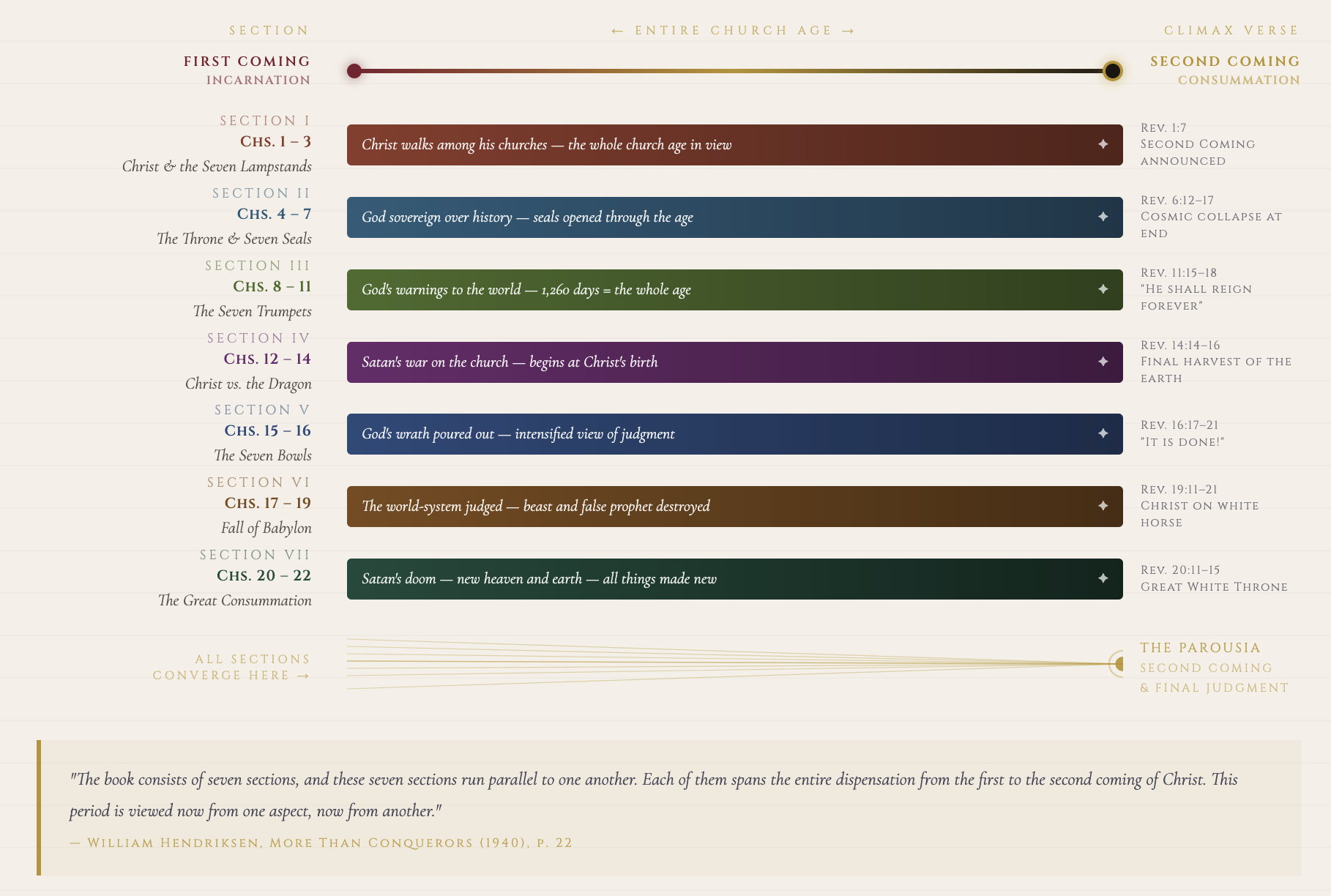
Hendriksen shows how Revelation divides into seven major sections, each covering the entire period from Christ’s first coming to his second coming, viewed from a different angle each time. He calls this progressive parallelism (also known as recapitulationism). It isn’t imported from outside the text. The text itself demands it. A clear evidence that this is how Revelation is written is seeing that the end of the world occurs not once but seven times across the book (Rev. 1:7; 6:12–17; 11:15–18; 14:14–16; 16:17–21; 19:11–21; 20:11–15). A strictly linear reading has no satisfying explanation for this. On the other hand, parallelism takes the text at face value and sees these are not different periods stacked end to end, but the same era with the same ending described repeatedly, each time through different imagery (see chart below for a visual).
This matters because structure governs meaning. If Revelation is parallel rather than sequential, then treating it as a prophetic timeline of future geopolitical events misreads the book’s own architecture.
4. The numbers and symbols are symbolic, not literal codes to be cracked
A futurist reading of Revelation (i.e. it all happens in the future) tends to treat the numbers and imagery of Revelation with a kind of hyper-literalism that the text itself does not support. The 144,000 are not a specific ethnic group to be identified. The “mark of the beast” is not a microchip. Babylon is not a rebuilt literal city. And, to crush one of my personal favorites, the steel-armored locusts are not Apache Helicopters.
Instead, Revelation opens by telling us it was “signified.” That is, communicated through signs and symbols (Rev. 1:1). The genre of writing — apocalytpic literature, which deals heavily symbols — supports this. Hendriksen argues that the seven churches represent the whole Church throughout history (seven being the number of completeness) and that the various beasts, bowls, and numbers are symbolic descriptions of spiritual realities experiences by all Christians at all times in all places, not encrypted predictions about specific modern nations or politicians. Revelation is truth! But we must not fail to recognize it is truth preached through symbol.
Taking symbols literally will not clarify, but confuse and distort the text. If I take Jesus’ claim, “I am the door” literally and not metaphorically, things get weird quickly. In the same way, when we treat the symbols literally we’re being less accurate in our interpretation, not more. Revelation is a vision of true, authoritative truths given in symbols and it does us well to read it as such.
5. Prophecy charts have a poor track record
The commentary Hendriksen speaks about on his desk — the one that confidently taught Napoleon, Kaiser Wilhelm, Hitler, and Mussolini were in Revelation’s pages — reminds us that our confident proclamations about who the Anti-Christ is, which nation is Gog and Magog, and when the world is going to end aren’t often, well, correct. That 19th commentary was written with the same confidence that today’s prophecy teachers have when they speak about the European Union, Russia, and microchips. Napoleon did not fulfill those prophecies. Neither did Kaiser Wilhelm. Neither did Hitler. The “prophecy” commentaries of each era have found their generation’s villains in the text with total confidence and have been wrong every time.
This is a problem. It is also a pattern. If Hendriksen’s view of progressive parallelism is correct, then we can know why the prophecy charts never pan out. If Revelation is not a sequential timeline of future geopolitical events, then every attempt to map it onto current events will eventually fail because that is not what the book is doing.
6. The book’s real message is more better and more radical than a timeline
The most important thing Hendriksen shows in Revelation is the pastoral weight of its content. Revelation is not asking, “Can you identify the Antichrist?” It is asking: “Can you hold on?” Remember, Revelation is a book written to originally to people who were losing, looked defeated, who were dying and it preaches to those suffering people: things are not what they seem. The Lamb has already won. Your prayers are moving history (Rev. 8:3–4). Your death is precious to God. The beast who seems to be winning is already cooked. You’ve got crowns. Yes, they’re causing you some pain, but hold onto them. He says:
“(Christ) conquers death, Hades, the dragon, the beast, the false prophet, and the men who worship the beast. He is victorious; as a result, so are we, even when we seem to be hopelessly defeated.”
That word is for persecuted Christians in Nigeria, in North Korea, in China, and everywhere else. That’ll preach in the 4th, 11th, and 21st century. That is not a message for American readers trying to figure out if Putin is the Anti-Christ, but the Christian who is struggling to follow Jesus in a world that hates him.
Could Your Reading of Revelation Be Improved?
None of this is to say that Revelation has nothing to say about the future. Hendriksen fully believes in the Second Coming, the final judgment, the new heaven and earth. He knows Revelation has something to say about those things too because it ends with a glorious vision of the final, future hope.
But there is a difference between a book that climaxes in the future and a book that is primarily a map of the future. Revelation is the former. Reading it confidently as the latter has a long and unbroken track record of embarrassment, distraction, and most importantly, missing the actual comfort and courage the book gives us.
If you’re not convinced, but open, pick up Hendriksen and hear his arguments. At the end of the day, we should all avoid believing things because they’re familiar or they’re comfortable, but to believe things because we’re convinced it is what Scripture teaches. If it is possible that there is a different way of reading Revelation that doesn’t end with prophecy charts, are you open to investigate?
You have probably been in this conversation before.
You’re talking with a friend, a family member, or a stranger online about something you both care deeply about like sexuality, justice, parenting, politics, or faith. No matter what you say, no matter how carefully you explain yourself, it feels like they are hearing a completely different language. You walk away frustrated, maybe a little hurt. You’re convinced either you are the worst communicator in history or that the other person is a wicked fool. To make it worse, they likely feel the same way about you.
What is going on?
A psychologist named Jonathan Haidt tried to answer that question in his book, The Righteous Mind: Why Good People Are Divided by Politics and Religion. His answer, though he is a non-Christian, is a very useful tool believers can pick up to engage our deeply divided world about questions of what is good, beautiful, and true.
In this book, Haidt sets out to understand why moral disagreements are so bitter, so persistent, and so impervious to argument. He discovered that most moral disagreements are not primarily about facts or logic, but values. You cannot win an argument about what is wrong if the other person doesn’t agree with you about what is valuable. Actions, and our judgments of them, are downstream values.
Imagine you are trying to explain why a piece of music is beautiful to someone, but they’re hard of hearing. You are not wrong about the music. They are not stupid. They just don’t hear what you hear. That is, in essence, what is happening in many of our most heated moral debates.
To get somewhere in conversation, we need to go past what people are saying to why their saying it.
Six Moral Foundations: A Map of Human Conscience
Haidt developed what he calls Moral Foundations Theory. He identified six core moral “taste receptors”, innate psychological systems that all human beings carry, but that different people and cultures dial up or down in different proportions.
Here they are:
1. Care / Harm
The deep human instinct to protect the vulnerable and avoid causing suffering. This is the foundation behind compassion, kindness, and outrage at cruelty. This asks. “Is someone being hurt?”
2. Fairness / Cheating
The instinct for justice and reciprocity. It wants people to be treated rightly and cheaters to not prosper. The questions here are, “Is this fair? Is someone being cheated?”
3. Loyalty / Betrayal
The instinct that binds communities together. It values those who are faithful to the group and condemns those who betray it. It inquires, “Is someone being disloyal? Is the community being protected?”
4. Authority / Subversion
The instinct for social order, leadership, and legitimate hierarchy. It recognizes that some structures, traditions, and authorities deserve respect and obedience for the good of all people. It’s focus, “Is someone undermining legitimate order?”
5. Sanctity / Degradation
The instinct that some things are sacred, noble, or pure by nature. To degrade these things is genuinely wrong, regardless of whether anyone is “harmed” in a physical sense or even if consent is offered. Its question, “Is something sacred being profaned or degraded?”
6. Liberty / Oppression
The instinct that individuals deserve freedom from domination and coercion. When people feel that a powerful force is crushing the rights of ordinary people, this is the line they feel is being crossed. “Is someone being unjustly controlled or oppressed?”
Haidt’s key finding is this: all six foundations are real, all six are human, and all six are weighted very differently by different people. To use an example from modern American politics, Progressives tend to rely most heavily on Care, Fairness, and Liberty. Conservatives draw more evenly from all six, making sure Loyalty, Authority, and Sanctity are not forgotten along the way.
This is not a small difference in emphasis. It means that in many moral arguments, one side is raising a genuine moral concern and the other side is not hearing it at all because they don’t share the concern.
Why This Matters for Christians
Why should a Christian care about the theory of a secular psychologist? Three reasons.
1. It’s Largely True
The moral foundations Haidt identifies are not inventions. They are discoveries. He found them embedded in human cultures across the globe; in Brazil and India, in conservative and progressive communities, in religious and secular settings alike. That kind of cross-cultural universality is exactly what you would expect if these intuitions were part of our created design rather than mere social convention.
Paul writes in Romans 2:15 that Gentiles who have never read the Law “show that the work of the law is written on their hearts, while their conscience also bears witness.” Haidt’s research is a perfect example of that truth. These moral foundations are tattooed onto every human heart by its Maker.
2. It Explains What the Bible Says
The Bible tells us that the human conscience is real but corrupted. It is there, but it is disordered. This means all humans have genuine moral instincts, but sin has distorted how we apply them and which ones we emphasize. Haidt shows that people do not lack morality, we just use it badly. We amplify certain instincts while suppressing others. We call good evil and evil good. Again, not because we have no moral sense, but because our sense of morality has been bent by sin and its ensuing stupidity.
Haidt does moral psychology. The Bible is does moral theology. They are looking at the same human being from different angles or reading different books, but, in many ways, they’re the same thing.
3. It Makes Us Better at Conversations
When you are talking with someone who doesn’t share your Christian convictions, it is helpful to remember they are not operating in a moral vacuum. They do have moral foundations, they are just weighting and applying those foundations differently than you are.
Haidt’s research reveals one of the main reasons conversations about sexuality, gender, life, justice, and family go nowhere: we often share completely different moral concerns. Christians who speak about Sanctity, “this degrades what is holy,” are dismissed as Puritanical weirdos by progressives. Progressives raise the moral concern of Care, “this hurts people,” and the conservative may be eager to dismiss their claim as manipulative emotionalism. In both, the conversation dies before it begins.
Here is how Haidt’s list helps me: if I can learn to identify which moral foundations someone is reasoning from, I can stop arguing past them and start speaking to what they actually care about. You are not compromising. You are translating.
Here’s an example: you are not going to convince someone who weights Care and Liberty above all else that pornography or sexually provocative entertainment is harmful primarily by appealing to Sanctity. But you can appeal to the harm it does to real people. You could point out how they exploit women in the industry, destroy marriages, rewire the minds and pursuits of the young men who watch it. If I begin with Care and Fairness, I am speaking their language. Then, once I have established the real, shared moral common ground, I’ve a fighting chance to produce more light than heat. This is not manipulation. It is wisdom. It is the difference between throwing a rope and watching someone drown and actually tying the knot where they can grab it.
A Caution for Christians
Before I close, one honest caution. Haidt’s theory is descriptive, not prescriptive. He is telling us how people actually reason about morality, not what morality ultimately is. He is a moral pluralist. He believes all six foundations are equally valid human concerns and that no tradition has a corner on moral truth.
Christians won’t agree with that because God doesn’t. Scripture is clear that moral truth is not merely discovered in our intuitions but revealed by God. The six foundations are real, but they can all be corrupted, misapplied, and weaponized. Care without truth becomes toxic empathy. Fairness without God’s definitions of property rights becomes communism or the worst kinds of DEI. Sanctity without the gospel becomes self-righteous moralism. The foundations need a foundation! The foundation of all foundations is not found by intuition alone but the character of God revealed in Scripture and embodied in Christ.
So, use this as a tool. It is a good one. But use it the way a surgeon uses a scalpel: carefully, in service of something greater than itself.
The Bottom Line
For Christians, Haidt’s framework is both a confirmation of what Scripture says about the universal human conscience and a practical key for engaging people whose moral language feels foreign. Don’t abandon your convictions, but learn to translate them.
Empathy is having a moment. It’s often leveraged to shame believers away from speaking or even thinking about certain topics. To question it or critique it can sound heartless, unchristian, or cruel. After all, aren’t Christians supposed to care? To weep with those who weep? To love our neighbors?
Yes. Absolutely.
But, and remember this, not every form of empathy is good. Some forms of empathy, especially when detached from truth, can deform Christian judgment, discipleship, and even love itself. It wears a pretty mask and carries an ugly dagger.
Bad empathy isn’t caring too much. It’s caring in the wrong way.
Joe Rigney draws a distinction between traditional Christian sympathy (or compassion) and what he calls “the sin of empathy.” He describes the sin of empathy as an excess of compassion that dulls judgment and detach believers from truth. This kind of empathy sweeps us “off our feet” and is “unmoored from truth, goodness, and reality” (p. xiv). It leads us away from wisdom, causes us to lose sight of what’s really good for ourselves and others, and makes us primed for manipulation. It doesn’t help, but actually hinders our ability to love.
Allie Beth Stuckey calls the phenomenon “toxic empathy.” She argues that empathy has been co-opted culturally to push or protect choice political stances (e.g. abortion, gender, immigration, social justice) as the only compassionate choices. Stuckey points out that this kind of empathy is often used to manipulate believers to affirm positions based on how others feel rather than what God has lovingly revealed in his Word.
It’s worth remembering that God alone can create and all he creates is good. Satan, on the other hand, cannot create, but only distort God’s good creation. Today, his distorting work seems especially evident in the way the virtue of compassion is being twisted into something harmful and dangerous.
Why This Matters for Christians
Recognizing the existence and damage of this kind of empathy is important not so we can win our political debates on Facebook, but so we can live and love wisely in Christ. It isn’t a political issue. At its core, it’s a discipleship issue.
Bad empathy shows up in much modern parenting decisions when our actions are determined by the goal of, “I don’t want to upset my kids.” Pastors can avoid saying what’s needed in fear of it hurting feelings. In important conversations about sexuality, justice, or immigration, normal Christians will feel cowed away from affirming out self-evident truths like, “It is good to have strong national borders” or “A man cannot become a woman” in fear of harming the marginalized, causing trauma, or being accused as heartless.
Though this kind of empathy looks and feels loving, in reality, it withholds what people actually need. Jesus never sets love against truth. He teaches that love requires truth. Sometimes the only way to know who truly loves you is by noticing who is willing to say the hard, painful, but necessary thing. At times, enemies offer kisses while friends deliver wounds (Proverbs 27:6).
Insights Worth Remembering
From both books, a few insights stand out as worthy to remember:
Compassion is not emotional surrender. Christians are called to care deeply for others according to the truth without being emotionally hijacked.
Feelings are real, but not authoritative. Emotional identification alone does not and cannot determine truth.
Love sometimes says “no.” Any kind of empathy that compels Christians to affirm what God calls sinful is distorted, dangerous, and deadly.
Truth orders empathy. Empathy must not rewrite truth. Our care for others must groundeed in reality expressed most clearly by biblical wisdom rather than cultural sentiment or how someone may feel about it. By all means, speak the truth as gently and wisely as possible, but make sure it is truth you’re actually speaking.
Jesus is our model. Even casual readers of the New Testament will see Jesus was simultaneously full of mercy and truth. He was never manipulated into acting or speaking from hijacked emotion or how he may come off. He spoke the truth from love and loved people to the truth.
Be Prepared
Bad empathy will show up in your life. It’s inevitable. It will arrive wearing the costume of care, justice, and love and it will ask you to trade discernment for sentimentality. Are you prepared to face it?
This doesn’t mean Christians need colder hearts. It does mean we need wiser ones. If we want to love well amidst the confusion, we must learn to resist counterfeit compassion and recover a love that is both tender and rooted in truth.