
When a public figure posts something foolish, blasphemous, or beneath the dignity of their office, Christians who voted or support that figure in any way often face an immediate accusation: you are a hypocrite. How could you vote someone who doesn’t live up to your own faith?
The answer is simpler than the accusation assumes: Christians don’t require their political leaders to be Christians, or even moral exemplars in every way.
What Is Not Hypocritical
This is an observable pattern that goes back to Rome. The early church prayed for Caesar, submitted to governing authorities (Romans 13), and sought the welfare of cities in which they were strangers (Jeremiah 29:7). None of these things were done with the qualifier that their leaders share their faith or character.
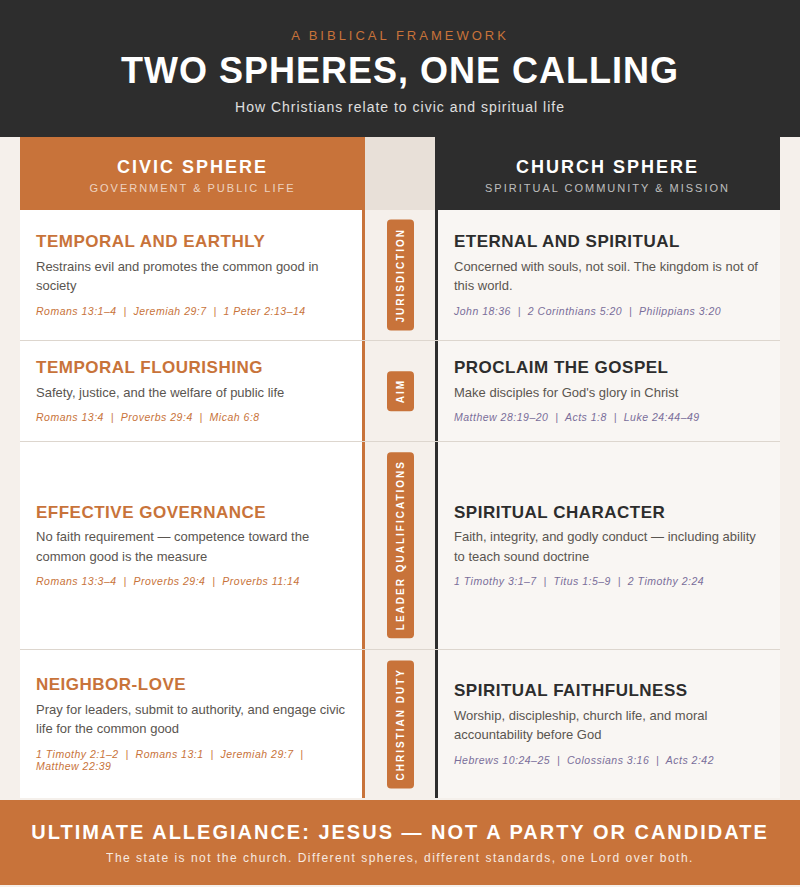
The reason is straightforward: civic life and church life operate in different spheres, have different qualifications for leadership, and have different aims. The state is not the church so we relate to her differently. We rightly require our pastors to meet high spiritual qualifications (1 Timothy 3, Titus 1), but we require no such thing of our mayors, senators, or presidents. The church’s mission is to proclaim the gospel of Jesus to make and grow disciples (Matthew 28:18-20). The government’s mission is not the salvation of souls but the ordering of society. As Paul says in Romans 13, to restrain evil and promote the common good. These are different goals, held by different kinds of institutions, accountable to different standards. A leader can fulfill the aims of civil office without being a Christian.
The distinction is not complicated. The chart below fleshes out the two spheres (civic and spiritual) across four categories: their jurisdiction, their aim, the qualifications they require of leaders, and the duties they call Christians to fulfill.
Surely, Christians ought to prefer leaders of integrity and principle. Where competence exists, character and faith only strengthen it. But preference is not requirement.
Given the reality of these two distinct spheres, the question for a Christian at the ballot box is not, Is this person morally worthy of my approval? but, Which candidate will govern best toward the common good? That is a policy question where there is a lot of room for disagreement amongst believers. A Christian’s vote isn’t about spiritual faithfulness within the church, but neighbor-love for the nation.
That said, it is worth noting that the range of legitimate Christian political disagreement has limits. While there is real liberty in how Christians weigh competing policy priorities, some platforms move far enough from basic Christian beliefs and values that supporting them requires increasingly significant theological compromise. Without turning this into a separate post, I will simply say that the current Democratic platform has, in my view, drifted into that territory in ways that make enthusiastic Christian support difficult to reconcile with historic Christian teaching. But that asymmetry does not change the basic question every Christian voter must still answer. Casting a vote is not a full character endorsement nor a baptism. It is an imperfect attempt to love the people around you by supporting whomever you believe will serve them best.
This means a Christian can vote for a candidate and still condemn that candidate’s sin without being hypocritical. These two things are not in tension. They never were. The vote is about policy and governance. The condemnation is about moral accountability. Both are Christian responsibilities.
That said, the hypocrisy charge doesn’t disappear entirely. It just belongs somewhere else.
What Is Hypocritical
There are two kinds of people who stand on completely different sides of the political aisle, but are mirror images of each other. The first defends everything their preferred leader does and refuses to condemn any wrong. The second condemns everything the opposing leader does while never acknowledging any good. Both trade eternal principles for temporal team jerseys. Both let political identity become the standard by which they judge.
The consistent Christian position is neither. For those we support and don’t support, Christians must be willing to call out wrong when wrong occurs. For those we reject, we must refuse the impulse to reduce that person entirely to their worst moments or best ones. As lovers of the truth, Christians must grow in their skill and practice of calling balls and strikes. This isn’t easy. It requires courage, intellectual honesty, nuanced moral reasoning, and theological maturity that goes beyond Bible verses painted on coffee mugs. Sadly, in the absence of those things many people opt for reactive, mindless partisanship instead.
Some Questions for the One in the Mirror
It is not difficult to critique a leader you did not vote for. The real test is whether you will critique the leaders you did support. I was encouraged to see that, after President Trump’s latest foible, many of those who voted for or supported him publicly condemned his recent post passed that test. The question worth asking is whether people, Christians especially, on the other side of the aisle will apply the same standard to their own preferred figures when the moment comes.
Here are three diagnostic questions worth asking yourself:
When a candidate I oppose does something genuinely good, am I willing to say so? If the honest answer is no, or if the question feels uncomfortable, that is a sign that political identity has outpaced moral integrity.
When a candidate I support does something wrong, am I willing to name it clearly? Not just privately, not only with excessive qualification, but with the same directness I would apply to someone on the other side. If the standard shifts depending on who is doing the wrong, do you even have a standard?
Do I hold my preferred leaders to the same measure I apply to those I oppose? Consistency does not mean treating every failure as equally serious. It means the framework does not change based on the jersey.
These questions are not best asked to others, but to the one in the mirror. The only political tribalism we have the power to heal is our own, so start there. As believers, our ultimate allegiance is never to a party or a candidate, but to Jesus.
Consistency is not complicated, but it sure is countercultural. With such a divided day, it might be one of the clearest witnesses a Christian can offer.