A Vision of the Lost

If this doesn’t fire you up, your wood is wet.

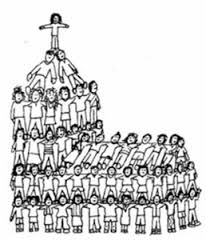
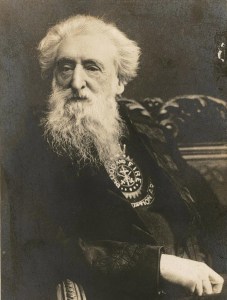
William Booth, the founder of The Salvation Army, once shared this vision:

I saw a dark and stormy ocean. Over it the black clouds hung heavily; through them every now and then vivid lightening flashed and loud thunder rolled, while the winds moaned, and the waves rose and foamed, towered and broke, only to rise and foam, tower and break again.

In that ocean I thought I saw myriads of poor human beings plunging and floating, shouting and shrieking, cursing and struggling and drowning; and as they cursed and screamed they rose and shrieked again, and then some sank to rise no more.

And I saw out of this dark angry ocean, a mighty rock that rose up with it’s summit towering high above the black clouds that overhung the stormy sea. And all around the base of this great rock I saw a vast platform. Onto this platform, I saw with delight a number of the poor struggling, drowning wretches continually climbing out of the angry ocean. And I saw that a few of those who were already safe on the platform were helping the poor creatures still in the angry waters to reach the place of safety.

On looking more closely I found a number of those who had been rescued, industriously working and scheming by ladders, ropes, boats and other means more effective, to deliver the poor strugglers out of the sea. Here and there were some who actually jumped into the water, regardless of the consequences in their passion to “rescue the perishing.” And I hardly know which gladdened me the most- the sight of the poor drowning people climbing onto the rocks reaching a place of safety, or the devotion and self-sacrifice of those whose whole being was wrapped up in the effort for their deliverance.

As I looked on, I saw that the occupants of that platform were quite a mixed company. That is, they were divided into different “sets” or classes, and they occupied themselves with different pleasures and employments. But only a very few of them seemed to make it their business to get the people out of the sea.

But what puzzled me most was the fact that though all of them had been rescued at one time or another from the ocean, nearly everyone seemed to have forgotten all about it. Anyway, it seemed the memory of its darkness and danger no longer troubled them at all. And what seemed equally strange and perplexing to me was that these people did not even seem to have any care- that is any agonizing care- about the poor perishing ones who were struggling and drowning right before their very eyes…many of whom were their own husbands and wives, brothers and sisters and even their own children.

Read the whole vision here.
Posted in Uncategorized | Tagged , | 2 Comments

I Am Built on Blood

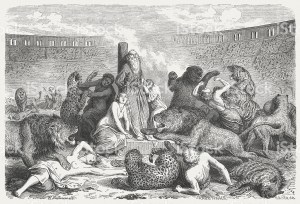
Christians are a people who exist because our Christ has spilled His blood as the substitutionary sacrifice for our sins. He died the death we deserved and thus paid the penalty for our sins in full. We are a people bought by blood (1 Corinthians 6:20; 1 Peter 1:18-19).

However, the blood of Christ was not the only blood shed to make us what we are. Kevin Miller explains:

“You and I would not and could not hold faith in Christ today, if many of the early Christians had not marched into the arena or toiled in the mines, unbent and uncompromised… Each time you and I meet a Christian, we are viewing a monument to the unknown early Christian martyrs.

Kevin A. Miller, “Tomb of the Unknown Christians,” Christian History 9, no. 27 (1990): 2.

Thank God for sending His Son to shed His blood for our life and thank Jesus sending His people to shed their blood to bring us the message of His life giving sacrifice.

We are their monument; built on their blood.

Posted in Uncategorized | Tagged , | Leave a comment

One Practice & Three Counsels to Attack Your Child’s Constant Boredom

If you are like most parents, you often hear your child complain, “I’m bored.” There are various approaches parents take in dealing with their child’s plight, but I found Julie Lowe’s simple response to her children’s boredom intriguing and helpful.

Julie Lowe explains:

We told our children that every time we hear the words, “I’m bored” (and all versions of boredom: “I’m tired”, “Nothing to do”, etc.), we would assign a chore to do. It didn’t take long before the words slipped out and thereafter, my kids appeared to find ways to occupy their time.

But Lowe notes that though this technique may change the behavior of our kids, it won’t get to the more fundamental issues in their heart. In other words, it’ll change the fruit of verbally complaining about boredom, but not the root that continually causes boredom. It’ll erase the symptom, but not the sickness. It’s start, but not an end.

Knowing this, Lowe then gives three counsels for how parents can get at the heart of their frequently bored child.

1) Help Them Exchange Passive Entertainment to Active Engagement

“When left to their own devices, they will often turn first to technology which allows them to be passively entertained rather than actively engaged in a hobby or activity. By spending time on social media, video games, TV or movies, they are, quite literally, entertaining themselves to mindlessness. When there is a moment of silence or inactivity, the adversity of boredom descends upon them and they feel incapable of overcoming it. “

So help them exchange their go-to entertainment for actively engaging hobbies by introducing them to engaging activities like crafts, art, music, building, writing, reading, sports, robotics, and more. For a huge list of actively engaging options, here is a website dedicated to actively engaging hobbies.

2) Help Them Foster the Gift of Stillness

“There is something lost when we do not learn to just sit, to be quiet, swing on a hammock or take a walk without something bellowing in our ear. We all need to stop and smell the roses, experience creation, to cease striving and know that He is God. We need to learn to enjoy such moments as a delight, not a period of boredom. Like us, children need to learn to reflect, contemplate, and meditate on the things of God. How will that happen if we do not endeavor to instill this in our children?”

I personally believe of the best ways to do this is by learning to do it yourself. One of the things I am learning as I watch my fellow adults is that we often have no idea how to sit still. So, before helping your child foster the gift of stillness ask yourself if you even have it! Learn to be without the TV, the phone, or any other amusement device and your kids will pick up on the unique gift it is.

3) Help Them Think Outside of Themselves

“There is a world of need, service, job opportunities, education and life to be lived and they need to be nudged (or sometimes dragged) in the right direction. Teens are not going to wake up one day and feel charitable and ask to go serve in the local food pantry. It requires cultivating generosity and a desire to serve…As parents, we have to be willing to do the hard work of steering our kids towards service and imparting within them a desire to be other-centered.”

What are various family service projects at home, at church, or in your community that you could do with your child? In your example and leading (not just your words), how are you cultivating a servant’s heart in your child?

At the end, Lowe’s final word gives the principal behind the practices, as parents we must carefully study, “what captures their affections and (equip) them to thoughtfully steward their free time.” Find out the things that excite them and help them plan their schedule accordingly.

I encourage you to read her whole post here.

Posted in Uncategorized | Tagged | Leave a comment

Accepting Homosexuality May Reveal Bigotry

In a review of two books (one by Matthew Vines and the other by Ken Wilson) that argue for the acceptability of monogamous homosexuality for the Christian life, Tim Keller makes an insightful point about those who change their view about homosexuality after having met homosexual people themselves.

It is worthy of a slow, thoughtful read.

Tim Keller:

Vines and Wilson relate stories of people who were sure that the Bible condemned homosexuality. However, they were brought to a change of mind through getting to know gay people personally. It is certainly important for Christians who are not gay to hear the hearts and stories of people who are attracted to the same sex.

And when I see people discarding their older beliefs that homosexuality is sinful after engaging with loving, wise, gay people, I’m inclined to agree that those earlier views were likely defective. In fact, they must have been essentially a form of bigotry. They could not have been based on theological or ethical principles, or on an understanding of historical biblical teaching. They must have been grounded instead on a stereotype of gay people as worse sinners than others (which is itself a shallow theology of sin.) So I say good riddance to bigotry. However, the reality of bigotry cannot itself prove that the Bible never forbids homosexuality. We have to look to the text to determine that.

So, Christian, what do you believe about homosexuality and why do you believe it? Are your thoughts on sexuality based on bigotry and prejudice or the text of Scripture?

I encourage you to read the whole review here.

Posted in Uncategorized | Tagged , | Leave a comment

What Sets Christianity Apart?

Herman Bavinck:

The fundamental distinction between Christianity and other religions arises from the fact that in Scripture the initiative in religion is not taken by human beings but by God.

In pagan religions it is human beings who seek God (Acts 17:27). In every way they attempt to bring God down to themselves and into the dust (Romans 1:23), and by all kinds of methods they try to achieve power over God.

But in Scripture it is always God who seeks human beings. He creates them in His image and calls them after the fall. He saves Noah, chooses Abraham, gives His laws to Israel. He calls and equips the prophets. He sends His Son and sets apart the apostles. He will one day judge the living and the dead.

The religions of the nations, on the other hand, teach us to know human beings in their restlessness, misery, and discontent but also in their noble aspirations and their everlasting needs – human beings both in poverty and riches, their weakness and strength. The noblest fruit of these religions produces humanism. But Holy Scripture teaches us to know God in His coming to and search for human beings, in His compassion and grace, in His justice and His love.

(Taken from Reformed Dogmatics, Volume 1: Prolegomena, p. 327-328)

The thing that sets Christianity apart is the God it worships: the God who comes, seeks, and finds. This is why the symbol of Christianity is not a ladder for man to come to God, but a cross where God came for Man.

Posted in Uncategorized | Tagged , | Leave a comment

Why Church Hurts

A lot of people get hurt in churches, but that shouldn’t surprise us given what the church is: diverse members that are connected in one body. Christian church folk are truly and spiritually connected with one another and because of that we share our pleasures and pains. The Apostle Paul illustrates the implications:

The eye cannot say to the hand, “I have no need of you,” nor again the head to the feet, “I have no need of you”. . . If one member suffers, all suffer together; if one member is honored, all rejoice together. 1 Corinthians 12:21, 26

Jerry Bridges unpacks this illustration with a needed correction for how we often deal with hurt and pain within church.

Can you imagine the ear making the following comment to the eye? “Say, did you hear about the serious trouble the foot is having? My, my, isn’t it too bad? That foot surely ought to get his act together.” No, no, our bodies don’t behave that way at all! Instead the entire body cries out, “My foot hurts! I feel awful!”

Why does the whole body hurt when only one part is injured? It is because all the parts of the body make up one indivisible whole. And when one part hurts, no matter what the reason, the restorative powers of the entire body are brought to bear on that hurting member. Rather than attacking that suffering part or ignoring the problem, the rest of the body demonstrates concern for the part that hurts. This is the way the body of Christ should function…

Only as we become acutely aware of the truth that we are in fellowship with every other believer — like it or not — will we seek to work out the implications of that fellowship in loving concern and care for each other.

(Taken from True Community: The Biblical Practice of Koinonia [Kindle Locations 672-673])

Only by realizing we are one through Jesus will we begin to act like as one in Jesus.

Posted in Uncategorized | Tagged , | Leave a comment

Death is the Great Beginning

C.S. Lewis:

‘There was a real railway accident,’ said Aslan softly. ‘Your father and mother and all of you are as you used to call it in the Shadowlands – dead. The term is over: the holidays have begun. The dream is ended: this is the morning.’

And as He spoke He no longer looked to them like a lion; but the things that began to happen after that were so great and beautiful that I cannot write them. And for us this is the end of all the stories, and we can most truly say that they all lived happily ever after. But for them it was only the beginning of the real story. All their life in this world and all their adventures in Narnia had only been the cover and the title page: now at last they were beginning Chapter One of the Great Story which no one on earth has read: which goes on forever: in which every chapter is better than the one before.

(Taken from The Last Battle, Book 7 of The Chronicles of Narnia (New York: HarperCollins, 1956), 228.)

Posted in Uncategorized | Tagged , | Leave a comment

What God Doesn’t Command Us to Do for Other Believers

Ray Ortlund:

The beautiful “one another” commands of the New Testament are famous.|

But it is also striking to notice the “one anothers” that do not appear there.

For example, sanctify one another, humble one another, scrutinize one another, pressure one another, embarrass one another, corner one another, interrupt one another, defeat one another, sacrifice one another, shame one another, marginalize one another, exclude one another, judge one another, run one another’s lives, confess one another’s sins . . .

Why is this important? Because . . .

The kind of God we really believe in is revealed in how we treat one another. The lovely gospel of Jesus positions us to treat one another like royalty, and every non-gospel positions us to treat one another like dirt.  But we will follow through horizontally on whatever we really believe vertically.

Read the whole pose here.

Posted in Uncategorized | Tagged , | Leave a comment

Are You Going to Marry a Non-Believer?

In answering the question, “What can I say to my Christian friend who just got engaged to a non-Christian?” John Piper offers a question I think needs to be asked by anyone considering such a marriage.
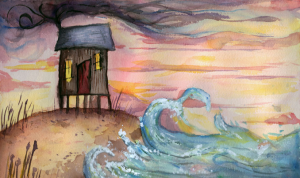
How can you be intimately, psychologically, spiritually, physically involved with a man who does not say “Jesus is Lord,” a man who doesn’t love your Savior?

He goes on to explain the thinking a believer must have in order to justify marrying a non-believer.

What is at root here is that she is loving this man more than she is loving Jesus. Because if she really loved Jesus—and he was satisfying to her, and her best friend, and walked with her, and talked with her, and sustained her—then the fact that he doesn’t love Christ but says, “I don’t want anything to do with him. He’s not my Lord. He’s not my Savior. I think that’s mythological and foolish,” that should tear her apart emotionally.

What is she saying by delighting in him when the essence of him is anti-Jesus? That’s who he is, he’s anti-Jesus! Women or men who go that direction show that their capacities for loving Christ have shrunk down, and they’re not feeling or thinking straight about loving Christ.

What does it mean to know him, love him, walk with him, cherish him, be satisfied in him, treasure him? It can’t mean what it should if a Jesus-rejector is valued as a husband over obedience to Christ.

Read the whole of John Piper’s answer here.

For more reading on the subject, check out these:

Posted in Uncategorized | Tagged , , | Leave a comment

Why the Bible & the Church Are Really Dangerous

Jesus once taught:

“Therefore everyone who hears these words of mine and puts them into practice is like a wise man who built his house on the rock. The rain came down, the streams rose, and the winds blew and beat against that house; yet it did not fall, because it had its foundation on the rock. But everyone who hears these words of mine and does not put them into practice is like a foolish man who built his house on sand. The rain came down, the streams rose, and the winds blew and beat against that house, and it fell with a great crash.” (Matthew 7:24-27).

John Stott explains the thrust of Jesus’ teaching:

The truth on which Jesus is insisting in these final two paragraphs of the Sermon is that neither an intellectual knowledge of him nor a verbal profession, though both are essential in themselves, can ever be a substitute for obedience. The question is not whether we say nice, polite, orthodox, enthusiastic things to or about Jesus; nor whether we hear his words, listening, studying, pondering and memorizing until our minds are stuffed with his teaching; but whether we do what we say and do what we know, in other words whether the lordship of Jesus which we profess is one of our life’s major realities.

John Stott takes a step further and powerfully applies the teaching:

In applying this teaching to ourselves, we need to consider that the Bible is a dangerous book to read, and that the church is a dangerous society to join. For in reading the Bible we hear the words of Christ, and in joining the church we say we believe in Christ. As a result, we belong to the company described by Jesus as both hearing his teaching and calling him Lord. Our membership therefore lays upon us the serious responsibility of ensuring that what we know and what we say is translated into what we do.

By listening to God’s Word and associating ourselves with God’s people we place ourselves under the weighty obligation to actually obey what we know and live according to what we confess to be.

Trust Jesus as Savior. Hear Jesus as Teacher. Obey Jesus as Master. There is no other way to joy or Heaven.

Posted in Uncategorized | Tagged | Leave a comment