
The Saturday Post(s)

Saturday Post

Pastor vs. Bomb Threat. A pastor’s letter to his church when a bomb threat targeted his church’s Christmas Eve service. “Nothing changes.  Come on if you planned to do so.  But, make things simple by not bringing a backpack, a package, or some big bulky anything, lest a choir member frisk you or strip search you. Nothing kills the Christmas spirit quicker.”

Top Ten YouTube Videos of 2015. If you want some year-end LOLs.

Yes & Amen in Jesus. What does it mean that God has promised us everything in Christ?

Christians & Guns. John Piper recently discouraged Christians to arm themselves with guns for personal protection. In response, Bob Thune and Douglas Wilson thoughtfully and respectfully wrote their disagreement. No matter where you land on the issue, whenever charitable and intelligent Christians discuss a disagreement, there are things to be learned.

7 Ways to Become a Better Sermon Listener. Good wisdom.

Wayne Grudem Has Parkinson’s Disease. Esteemed theologian and a personal hero of mine, Wayne Grudem, has recently been diagnosed with Parkinson’s Disease. His response here is encouraging to say the least.

The Circle. A new device designed to help protect your family digitally.

Did Jesus Even Exist? “Well, its that time of year.  Christmas is almost a week away and we are already seeing various media channels releasing stories, articles, and documentaries on Jesus.  And when the dust settles, they all make the same point: the real Jesus is a lot different than you think.”

The Show Must Go On. Even when you have hiccups.

Posted in Uncategorized | Tagged , , , , , , , , | Leave a comment

The Time Santa Claus Slapped a Jehovah’s Witness; Kind of.

st-nick-punches-arius

No coal in a stocking, just a slap on the face.

This Christmas, there will be lots of talk of Ol’ Saint Nick, but, agreeing with Nathan Busenitz, there is one Santa story that rules them all.

First, some background is needed.

Time and lore have turned the legend of Santa into a large, rosy-cheeked, white bearded, reindeer driving home invader, but the original Santa was quite different. He was known as Nicholas, he was the Bishop of Myra, and he lived in the 3rd and 4th century. As Nathan Busenitz notes, the real Nicholas of Myra was known to be extremely loving and generous to the poor, but he “did not live in the North Pole. He was not Scandinavian. He did not drive a team of magical caribou. He did not work with elves. Nor did he travel the world every Christmas Eve exchanging presents for milk and cookies.” Instead, he was a pastor and he worshiped the Lord Jesus Christ.

The Heretic Slapper

In 325AD, the Christian church gather together at Nicaea to help figure out a controversy stirred up by a man named Arius. Arius taught that Jesus, although divine, was not fully God, but instead the greatest creation of God (much like modern day Jehovah’s Witnesses teach). Arius maintained that Jesus was a creature of God instead of God the Creator. So, pastors from all around gathered to discuss the controversy (of which they eventually decided Arius had departed from the Biblical teaching about Jesus and condemned his teaching as heresy). It is at this very council where Bishop Nick of Myra won my heart.

William J. Bennett explains the story for us.

Tradition says that Nicholas was one of the bishops attending the great council [of Nicaea]. As he sat listening to Arius proclaim views that seemed to him blasphemous, his anger mounted. He must have asked himself: Did I suffer through all those years in prison to listen to this man betray our beliefs?

His anger got the best of him. He left his seat, walked up to Arius, faced him squarely, and slapped his face. The bishops were stunned.

Arius appealed to the emperor himself. “Should anyone who has the temerity to strike me in your presence go unpunished?” he demanded. . . .

[Consequently,] Nicholas found himself under lock and key in another wing of the palace.

But in the end, the bishop of Myra got the result he wanted. When the arguments were done, the council rebuked Arius for his beliefs. The bishops drew up a statement that came to be known as the Nicene Creed, which affirms faith in the Holy Trinity and declares that Jesus is “of one substance with the Father.”

Perhaps Constantine secretly enjoyed watching someone put Arius in his place. Perhaps some of the bishops admired Nicholas for standing up forcefully, if overzealously, for his beliefs. Nicholas must have had friends and supporters in high places, because when the Council of Nicaea concluded, he was set free and his clerical robes were restored.

(William J. Bennet, The True Saint Nicholas [New York: Simon & Schuster, 2009], 38-40.)

So, with the real Santa in mind, let’s rewrite all of our goofy, mythological Christmas songs about the gluttonous legalism and change them to honor the heretic punching, Jesus worshiping pastor of Myra.

HT: Nathan Busenitz


Posted in Uncategorized | Tagged , , | 1 Comment

Why Did Jesus Become a Man?

why-christmas-pptThis week our middle school and high school youth groups are ending a three-week mini-series seeking to answer the question, “Why Christmas?” Going beyond the explanation that Jesus is the “reason for the season,” we have been pushing them to think about why Jesus becoming a human man was necessary in the first place. More than asking, “What is Christmas all about?” we are wanting them to ask, “What is the incarnation of Jesus Christ all about?”

Our answer, over the course of three weeks, has been this:

Jesus Christ became a sinless man to become sinful Man’s perfect Prophet, Priest, and King.

The purpose of the incarnation was for Jesus to become all three of these offices for those who trust in Him. But what does it mean for Jesus to be our perfect Prophet, Priest, and King? The Heidelberg Catechism beautifully explains the significance of each office:

Question: Why is he called “Christ,” meaning, “anointed”?

Answer: Because he has been ordained by God the Father and has been anointed with the Holy Spirit to be…

our Chief Prophet and teacher (Acts 3:22; Deuteronomy 18:15) who fully reveals to us the secret counsel and will of God concerning our deliverance;

our only High Priest (Heb. 7:17; Ps. 110:4) who has delivered us by the one sacrifice of his body, and who continually pleads our cause with the Father;

and our Eternal King (Matthew 21:5; Zechariah 9:9) who governs us by his Word and Spirit, and who guards us and keeps us in the freedom he has won for us.

As our Prophet, Jesus informs our ignorance. As our Priest, Jesus atones for our sin. As our King, Jesus protects and provides for all our needs.

Posted in Uncategorized | Tagged , , , , , , , , | Leave a comment

Christianity Has Always Been An Organized Religion

william-haefeli-i-don-t-belong-to-an-organized-religion-my-religious-beliefs-are-way-too-new-yorker-cartoon

If the Church is precious to Jesus, don’t you think He’d want to organize it? I believe the answer is yes and I believe the Scriptures teach that God has given us instructions in His Word about how the church is to be organized.

Mark Dever & Jonathan Leeman do a good job surveying the basic idea.

Does Scripture intend to tell us how to organize our lives together as Christians in churches, or is polity a matter of biblical indifference, so that we are left to figure out our own best practices? “Does this work? What about that? Oops, just crushed a sheep. Anyone got a better idea?”

The New Testament, in fact, is filled with references to polity [church government]. In its pages we find that churches held corporate meetings (Acts 20: 7; Heb 10: 25) and elections (Acts 1: 23– 26; 6: 5– 6). They had officers (Acts 20: 17, 28; Phil 1: 1), practiced discipline (1 Corinthians 5), collected money (Rom 15: 26; 1 Cor 16: 1– 2), gave and received letters of commendation (Acts 18: 27; 2 Cor 3: 1), administered the ordinances (Acts 2: 41; 1 Cor 11: 23– 26), baptized and received members (Matt 28: 19; Acts 2: 47), and more. Clearly God has given directions in his Word about many aspects of the church’s corporate life and structure.

(Taken from Baptist Foundations: Church Government for an Anti-Institutional Age (Kindle Locations 281-294). B&H Publishing Group.)

The Christianity of the New Testament is organized. How about yours?

Posted in Uncategorized | Tagged , , , , , , , | Leave a comment

Authority Gives Life

image2Far from being a curse, authority, if it is good authority, is a gift from God’s open hand.

Mark Dever & Jonathan Leeman helpfully explain what good authority looks like:

Good authority authors life. It creates and empowers and uplifts. Yes, authority places boundaries on the road and writes rules for the game, but it does that so the game can be played and the destination reached.

Good authority is the coach who trains the runner to run faster, the teacher who teaches the student to build better. Again, authority authors life. Isn’t this precisely what God did with his authority by creating the world? And isn’t this what he meant for everyone created in his image to do by giving dominion to humanity? God’s authority is nothing if not generous. And so should ours be.

Taken from Baptist Foundations: Church Government for an Anti-Institutional Age (Kindle Locations 255-256). B&H Publishing Group. Kindle Edition.

Oh that our churches would be filled with such authority so it may produce Christians who practice such authority in whatever lot God has placed them!

Thank you, Father, for good authority.

Posted in Uncategorized | Tagged , , , , , | Leave a comment

The Saturday Post(s)

Saturday Post

If I Only Knew. The first three paragraphs will most likely get you to read the whole thing; which would be a very good thing.

I contracted polio long after it was supposedly eradicated. The doctor misdiagnosed my symptoms because she had never seen polio before. And the wrong diagnosis led to widespread paralysis. With a childhood spent largely in hospitals, marked by painful surgeries.

Over thirty years later, my infant son died because the substitute doctor was unfamiliar with his heart condition. The doctor took him off his life-saving medicine. Within two days, my son was gone.

How could I possibly reconcile these losses? They were unspeakable. Preventable. Unexpected. And in the face of such catastrophes, my natural question was, “Why?” Why did this happen? If God was in control, why did he allow it? Why didn’t he stop it? Why? Why? Why?

9 Consequences to Debt. “What are some of the consequences of a debt-laden lifestyle?” Here are nine.

Catching the Joy. A great reminder as Christmas nears. “I can’t imagine that in 20 years when my kids get together they will look back in joy on the year Mom finally figured out a way to keep the snow clothes tidy. A bunch of adults sitting around, ‘Remember that year when everything was clean before Christmas? That was the best! I hope we can do that for our kids this year!’”

If We Don’t Forgive Others, Will God Really Not Forgive Us? What does this passage mean? “For if you forgive others their trespasses, your heavenly Father will also forgive you, but if you do not forgive others their trespasses, neither will your Father forgive your trespasses” (Matthew 6:14-15).

Marriage, Divorce, & Remarriage. Regardless of where you land on this issue, this is some thoughtful commentary to think on.

Crash Course on Islam. It is becoming increasingly important for Christians to know about Islam. Here is a great starting place.

Modesty Lets Our Light Shine. Parents, this would be a great article to read with your girls (and boys too).

I Read the Bible & Feel Nothing. What Should I Do? “If I read my Bible, but I don’t feel anything in my affections that resonates with the worth, the value, the preciousness, the beauty, the pleasures of what those words are supposed to communicate, is there anything I can do next? Or do I just have to wait and let the experience happen to me in the future? How do you answer?”

Pizza Vending Machine. Yes, please.

Posted in Uncategorized | Tagged , , , , , , , , , , , , , , | Leave a comment

The General Who Pours Coffee

330598174_ef3a768156_bThe Apostle John relays a magnificent story about something Jesus did for His disciples in his last hours of life:

Jesus knew that the Father had put all things under his power, and that he had come from God and was returning to God; so he got up from the meal, took off his outer clothing, and wrapped a towel around his waist. After that, he poured water into a basin and began to wash his disciples’ feet, drying them with the towel that was wrapped around him. John 13:3-5

In a world of paved streets, socks, shoes, and Odor Eaters, sometimes the significance of footwashing evades us. Bible commentator, Gary Burge, helps fill in the gaps of our thinking.

The task of foot washing was so menial that according to some Jewish sources, Jewish slaves were exempt and the job was kept for Gentiles…

All our ancient sources show that foot washing was a degrading and lowly task. When done by a wife (for her husband), a child (for his/her parents), or a pupil (for his teacher), it was always an act of extreme devotion. But since it was an act with social implications, in no way do we find those with a “higher” status washing the feet of those beneath them.

When Jesus takes off his outer clothing and wraps a towel around himself (13:4), he is adopting the posture of a slave. (Taken from NIVAC, 369)

Jesus, the Eternal Son of God whom all Creation will one day bow in humble submission, bows in humble service to wash the grimy feet of His disciples. The Man of greatest glory assumes the job of greatest humility. The Exalted One deserving of service lowers Himself to serve.

Recalling a recent experience, Pastor Mark Altrogge illustrates this well:

A few weeks ago, I spoke at a small group leaders retreat in a beautiful Christian retreat center built and run by Christians in the military. Most of the staff were former military personnel. Some had served our nation recently. But all were serving the two groups having retreats that weekend. I noticed in particular an old man with white hair who looked to be in his 80’s or older going around the room every meal pouring coffee, in one hand a pot of regular and the other a pot of decaf. With a big smile and shaking hands, he poured cup after cup, meal after meal. There was also an elderly lady serving her heart out as well.

Before every meal in the cafeteria, one of the military men would lead us all in a short hymn or praise chorus, then pray before the meal. On the last morning after the prayer before breakfast the host said, “I’d like the General to come up please.” As everyone looked around, the old man with white hair who’d been pouring coffee slowly made his way to the front. The General! This was the guy who’d been pouring coffee. Serving everyone there. A General!

From the mouth of Jesus Himself:

For even the Son of Man did not come to be served, but to serve, and to give his life as a ransom for many. Mark 10:45

Hallelujah, what a General. Not One who poured coffee, but One who poured out His life for those He loved.

Posted in Uncategorized | Tagged , , | Leave a comment

My Weaknesses as a Preacher

Bible-on-a-pulpitCharles Spurgeon once said, “If you seek humility, try hard work; if you would know your nothingness, attempt some great thing for Jesus.

There are a lot of hard things this statement could be referring to, but for me, the hard work that has humbled me time and time again has been preaching. Preaching crushes me to dust. I know that when some people preach, they grow proud. But that has not been my experience. Preaching for me feels like getting spiritually punched in the gut. I (almost) always feel beaten and bruised when I descend the pulpit.

Why is this? I think for two reasons, at least. One, God’s Word is too glorious to ever do justice to. I do not think I will ever feel like I have adequately explained and applied the Bible because the Bible is too beautiful and significant to be expounded by my weak lips. Second, I am too weak. Whether it be my distracting quirks, my faltering articulation, or my sin, I constantly find much more to improve in my preaching than I do to be proud of. Both the greatness of the gospel and the weakness of the preacher make for quite a humbling experience week after week.

In thinking about the humbling nature of preaching, I found myself reflecting much on my weaknesses as a preacher. These reflections, far from being a bummer experience for me, were encouraging and beneficial. It is helpful to the soul to be reminded that although my preaching is chained to my weaknesses and limitation, God’s Word is not. Even through my failings God will succeed.

Why Share My Weaknesses as a Preacher?
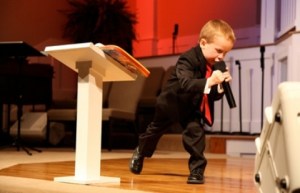
1.Kanon Tipton Preaches.jpg

Bringin’ the fire

What I would like to do now is publicly acknowledge what I think to be my greatest weaknesses as a preacher? But before I do that, I think it may be helpful to ask, “Why would I do such a thing?” Am I attempting to make you think I am a humble fellow? Am I fishing for compliments? After much self-examination (this post has been brewing in me for awhile), I can, as best as I am able with a clear conscience, say “No” to both of options. I am not doing this for those ends.

So again, why? A few reasons. First, I want to demand my heart continually recognize my weaknesses. I never want to be blind to my weaknesses and limitations because I know I will always have them and becoming blind to them means they won’t be improved or corrected. God forbid I doom myself to weakness when God is always desirous and willing to mature me. Pride chains us by never allowing God to change us.

Second, I want to destroy the idea others may have of me being almost-perfect. My online presence or public ministry may make it easy to think I am a super spiritual person without flaw, but, I most ardently assure you, I am not. Those who know me can tell you. This is an opportunity to let me readers adjust their view of me to what it should be: a desperately weak man with a magnificently faithful and patient Master.

Third, to encourage other preachers of teachers of God’s Word to acknowledge and own up to their weaknesses so they can continually seek the Lord’s help to improve themselves as preachers. This world needs the best preachers it can get. God’s Word is too good and this world is too bad to be OK with stagnant, stale, stunted preaching. You will always have room to grow and areas to correct and improve. Be vigilant. Be thoughtful. Be correctable. Always.

My Weaknesses as a Preacher
latest

Sometimes…

So, with that in mind, here are, what I think, my top 8 weaknesses as a preacher.

I am unnecessarily long-winded. All who know me are smirking as they read this one. Although I think longer sermons are generally more beneficial for churches today, I know my long-windedness is not intentional. I constantly go longer than I shoot for and often weary my listeners. Spurgeon has always encouraged and challenged me with these words, “We may sometimes say too much in a single sermon, and give our hearers a field of wheat instead of a loaf of bread.”

I can explain too much. This plays into my long-windedness. I often explain certain points to death. This is especially burdensome for listeners when the heavily explained points are merely sub-points. Fat sub-points slow down sermons.

I can explain too little. It isn’t uncommon for me to treat certain points in a superficial manner and gloss over them too quickly without engaging, explaining, and applying them.

My jokes can distract instead of help. Either because they’re dumb or offensive. Rarely because they’re too funny.

I am uncomfortable with silence and try to fill it in with empty words. A missionary visited our church recently and said, “Young man, you are a gifted teacher, but learn to take a breath.” Noted. Like a period in a sentence, silence can help link all your thoughts together in a graspable manner. You could even say that silence serves as an oratory period or paragraph break.

I can devote too little time to preparation. This has been especially true during the semester when school is in full swing.

I don’t always tether the sermon to the cross. I hate this. I believe the whole Bible ends in Christ so every sermon, no matter where you are in the Bible, should find itself tied to the cross in some organic and faithful way. I don’t always do this well. Again, to quote Spurgeon, “There ought to be enough of the gospel in every sermon to save a soul” (Soul Winner, p. 80).

My introductions are often too lengthy. In an effort to create a connection with the audience, I can easily spend 10+ minutes on an introduction.

What I Hope This Post Does

So, here’s what I would love for this post to bring about.

One, I would love for you to pray for me and other preachers in your life. Regardless if they own up to it or not, they have weaknesses that need improvement. Pray that they are those and seek the Spirit’s help to correct and grow in those areas.

Two, if you’re a preacher, I would love for this to bring you to examine your own preaching for your improvement. From preparation to final prayer, how can you improve your proclamatory skill so God’s Word would be most helpfully delivered?

Three, have patience on your preachers. It’s a terribly hard and humbling task that produces heartache like no other. Don’t stand against your church’s preachers or their preaching, but stand with them. Pray for them. Encourage them. Let them know you’re their friend and you appreciate their ministry and want to help them do what God has called them to do. They need it.

So, this post was longer than I anticipated. Go figure.

Posted in Uncategorized | 1 Comment

The Saturday Post(s)

Saturday Post

Women in Battle? “What kind of a society puts its women on the front lines to risk what only men should be called on to risk? In countries ravaged by war, we consider it a tragedy when the battle comes to the backyards of women and children. Why would we thrust our own wives and daughters into that horror? My own instinct is to keep them as far from it as possible.”

How to Know If You Are a Christian. There are a lot of people who need to be assured of their salvation and there are also lots of people who need to be unsure of their salvation, so they can be saved for real. Articles like this are helpful to both of those ends.

The Goodness of Thoughts & Prayers. The news has been saying that they don’t want prayers, but solutions. God isn’t fixing the situation. Andy Crouch answers by showing that, even though they don’t offer immediate solutions, prayers are a good thing to be had after the wake of tragedy.

Church or Crossfit? “There is something raw and vulnerable that happens to you when you go into the CrossFit gym,” Ms. Huberlie said. “A workout can bring you to your knees, so to speak.”

The Most Essential Life Skill. I could not grant a louder amen to this. “There’s one characteristic that separates the successful from the unsuccessful in every walk of life: teachability…No matter how much talent and gifting we have, if we are, or become, unteachable, we will never reach anywhere near our full potential in our careers, our callings, or our relationships.”

Should We Only Forgive Those Who Repent? “I have heard it taught that if a person does not seek forgiveness (repent) that we are not required to forgive, do you agree with this? Can a person refuse to forgive and not harbor sinful bitterness?”

6 Principles for Youth Ministry. There is so much goodness in here it makes my stomach ache.

Bean Bag Splosion. It’s all fun and games until 1:04 guy chooses to do a flip.

Posted in Uncategorized | Tagged , , , , , , , | Leave a comment

Why Do Christians Seem to Lose the TV Debates on Homosexuality?

thekingHave you ever noticed how TV “debates” about homosexuality between Christians and non-Christians often go terribly wrong for the Christian? In the course of such shows, the Christian almost inevitably ends up looking like a prejudiced knave and the supporters of for the sake of oppressed and marginalized humanity.



Have you ever wondered why?

Trevin Wax, in one of the most helpful pieces on the issue I have ever read, suggests this happens because of how the debate itself is framed. In these TV “debates,” the issue of homosexuality and Christianity is almost exclusively framed as a sin issue rather than a repentance issue.

Wax explains this point well in his analysis of a Larry King discussion between a confessing Christian, Lesbian woman, Jennifer Knapp, and a Christian pastor:

“We’re all sinners” comes up again and again in discussions like this. In her Larry King interview, Knapp realized the power of having the pastor admit that he too is a sinner. Once she received this admission, she had the upper hand in asking, “Then why are you judging me instead of me judging you?”

Whenever the discussion centers on “homosexuality is a sin… but we’re all sinners,” the traditionalist inevitably comes across looking like he is singling out homosexuality as a worse sin than all the rest. His protests to the contrary always ring hollow.

But this is the wrong way to frame this debate. We are not saying that some of us are worse sinners than others or that homosexuality is a worse sin than pride, stealing, etc. We are not categorized before God as ” better sinners” or “worse sinners.” Instead, we are either unrepentant or repentant. True Christianity hinges on repentance…

If we are to reframe this discussion along biblical lines, then we must emphasize the necessity of repentance for the Christian faith. The point is not that the pastor and the Knapp are both sinners. It’s that the pastor agrees with God about his sin, while Knapp remains in her sin without repentance. That is why he is questioning her Christianity, for Christian teaching makes clear the necessity of repentance as the entryway into the Christian family.

Ultimately, the debate is not about homosexuality versus other sins. It’s about whether or not repentance is integral to the Christian life.

I highly encourage you to read the whole post here.

The four points he makes in the post for how Christians can better dialogue about homosexuality are as follows:

  1. We need to shift emphasis from the truth that “everyone is a sinner” to the necessity of repentance.
  2. We must not allow ourselves to be defined by our sexual attractions.
  3. We must expose the arrogance and judgmentalism of those who would so flippantly dismiss the witness of Christians for two thousand years.
  4. We need soft hearts toward Christians struggling with same-sex attraction.

Think deeply about all four of these points. I think they’re all spot on. It is becoming more and more important for all Christians to diligently work to better articulate God’s Word on such a hot issue with such a hostile culture. The hope we have in Christ is too glorious to settle for sloppy words and half-baked thoughts about this and other issues our culture wants us to fold on. May we sharpen our tongues that Jesus may be honored and loved by all.

Posted in Uncategorized | Tagged , , , , | 1 Comment