

I’ve spent years thinking about preaching. First, as a listener at church. Later, as a pastor, the guy doing the preaching. Now, I teach it to new ministry students at Biola University, or at least I try.
One thing I have discovered through all this is that not all sermons are the same. On the face, it isn’t the most profound insight. We all know that sermons can be very different. But, outside of a calling a sermon good or bad, exciting or dull, or short or long, believers don’t always have the language to distinguish one sermon from another. Lacking the ability to articulate what we’re preaching or hearing keeps us from the discernment we need.
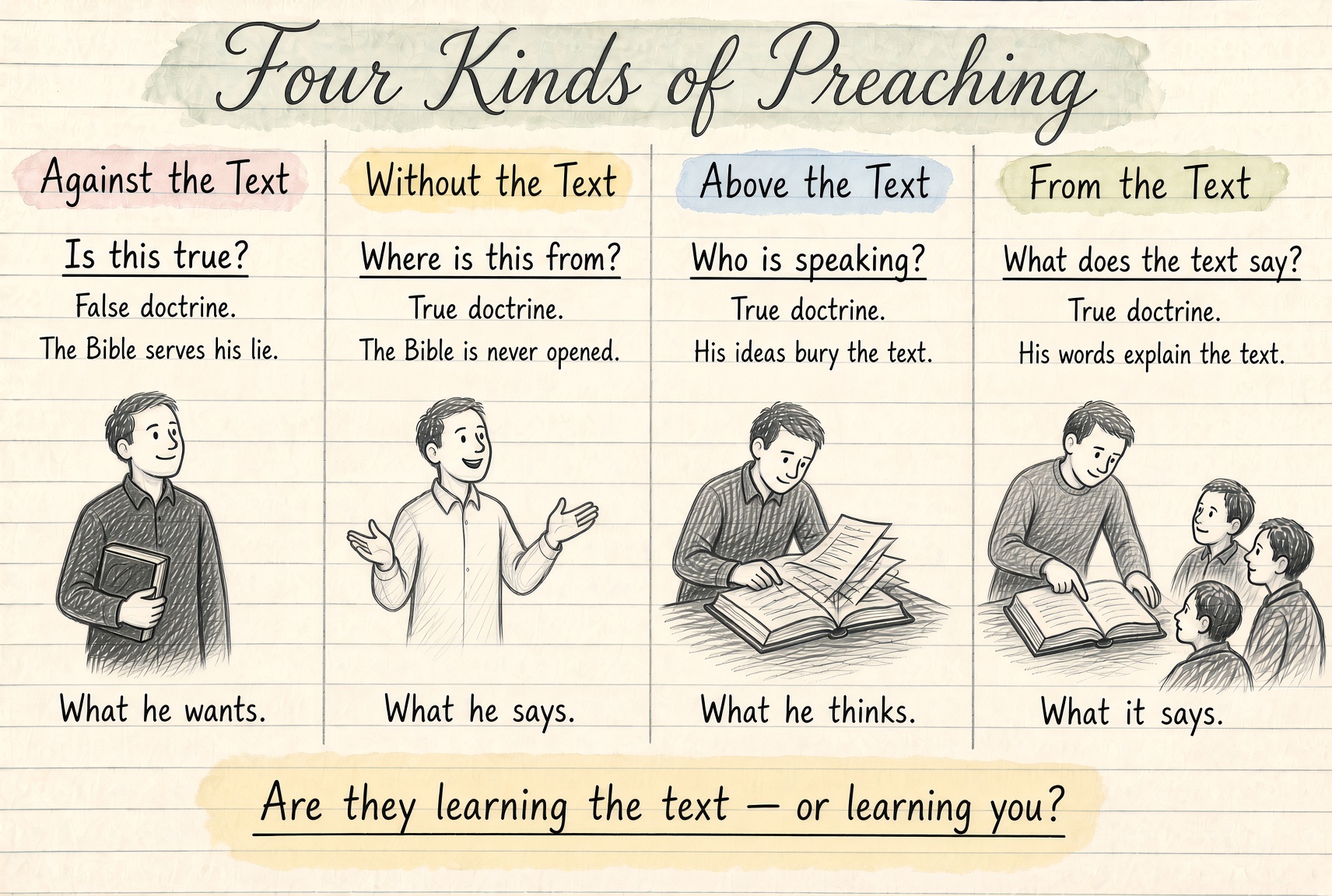
To help with this, I’ve come up with a taxonomy to identify four broad categories of sermons.
#1) Preaching Against the Text
The first category is identified by asking, “Is this true?”
This question doesn’t evaluate how good of a communicator the preacher is, but whether or not they or their message is actually Christian at all. It doesn’t measure whether a sermon is good or bad, but whether it is true or false. This is especially important to consider the more sermons are offering vital truths about God or the gospel.
The New Testament is filled with warnings against false teachings. Paul writes urgently to Timothy: “The Spirit clearly says that in later times some will abandon the faith and follow deceiving spirits and things taught by demons” (1 Timothy 4:1). Jude warns of false teachers who deny the Lord (Jude 1:4). These aren’t casual warnings. They’re written with the urgency of someone who understands that false doctrine is to faith what cancer is to the body: deadly.
This leads us to the first category of sermons: preaching against the text. One of the tricky things about preaching against the text is that someone can do it with or without the Bible. People can cite “faith that moves mountains” to persuade folks of the prosperity gospel. James can easily be proof-texted to teach salvation by works. The words of Jesus can easily be lifted from the rest of the Bible to justify same-sex relations, communism, or new age tomfoolery. Just because someone uses Scripture, it doesn’t necessarily mean the message is Scriptural. After all, people can do all things through a text ripped out of context. So, the question here isn’t, “Did he use the Bible?” but, “Did he say the things the Bible says or did he use the Bible to say what he wanted to say?”
If the doctrine is false, it doesn’t matter whether the preacher engages the text or ignores it entirely. He’s building on sand and offering a faith akin to a house of cards. False doctrine preached from the text (through ignoring, distorting, or selectively reading Scripture) is just as, if not more, destructive as false doctrine preached without it. The problem and key question focuses on the message, not the method.
So, the first most important question to ask is, “Is this Christian?” The next question is, “How is the text is being used?” The next three categories can help answer that.
#2) Preaching without the Text
This is a sermon where the preacher teaches right truths and knows what the Bible teaches, but doesn’t use the Bible to argue those truths. He proclaims and listeners are left to merely trust that it’s what the Bible says because, well, he said so.
Over the years I’ve seen this happen. A preacher talks about the love of God given to broken, sinful people. He may even allude or paraphrase certain passages from the Bible correctly, but none of his message has verses. Given my own knowledge, I see that the thrust of his message is distinctly Christian, but his sermon gives no one evidence that it’s biblical.
Though this could be done with good motives, he could be trying to communicate as simply and clearly as possible to a diverse audience, it is a method with consequences. In practice, it implies to listeners that the truths they’re hearing is the authority and Scripture is optional. It shifts people’s foundation from what God says in His Word to what their pastor says from the pulpit. Also, though it gives the correct whats of the faith, it does nothing to supply them the whys or the from wheres. Over time, this kind of preaching keeps believers naive, ill-equipped to read their Bibles, and unprepared to give the reasons for the faith they have in Jesus other than, “My pastor said this was true.”
Since Jesus is the Head of the Church, and not their pastor, it does them well to not just agree with His claims, but know where and how He offers them.
#3) Preaching above the Text
This is where a lot of evangelical preaching lives today. The preacher has the right doctrine and a genuine love for the Bible and he uses it in his messages, but the structure and delivery of his sermon gives the feel that doctrine comes first and the text second.
I once listened to a preacher teach on thanksgiving from Ephesians 5:18-21. The whole sermon was on the importance thankfulness for the Christian life. He preached good, true, and even helpful ideas, but the majority of his sermon was his explanation of thanksgiving from a passage where the word shows up once as the third sub-thought in a list of four under the broader charge to “be filled with the Spirit”. His explanations and ideas, which were fine, buried the actual passage. By the end of the sermon, most of the passage was untouched, untaught, and its own internal reasoning buried under the preachers fine ideas. People walked away with some good ideas about thanksgiving, but none walked away understanding Ephesians 5:18-21.
This kind of preaching looks faithful and is better than #2 and especially #1, but it has four significant consequences. First, it undercuts the authority of God’s Word by subtly shifting the congregation’s attention to what their preacher says about a text rather than what the text is saying. Over time, his ideas become canon. Second, it undercuts the aim sermons ought to have. Preachers are supposed to teach what the text says rather than what they think about the text. Third, it trains congregations to listen for the familiar doctrine and to read Scripture the same way. They learn to scan the text for support for what they already think and lose the opportunity to be surprised by Scripture. They don’t learn to follow an argument or to let the text say things they didn’t expect. Fourth, it weakens discernment. If an incorrect idea is taught or something is ripped out of context, these congregants are ill-equipped to notice because they lack the practice and ability to read the text carefully. They’ve been trained to listen to the speaker, not the writer. Though faithfulness to sound doctrine is important, how one teaches it isn’t unimportant.
#4) Preaching from the Text
I remember one pastor explaining the preacher’s job like this, “Read the text, explain the text, apply the text.” I think that about sums up the job and this last category of preaching.
This kind of preacher starts and ends differently than the others. He choose a text, does the hard work of studying it: its context, its words, sentences, paragraphs, flow of thought, and main idea. Then, from that joyful labor he seeks to say what the text says in plain language from the text. He is a holy parrot, not offering mindless repetition, but refusing to mistalk or outtalk the passage. He says only what the passage says, explains it in a plain way, and applies it to the minds, hearts, and lives of his hearers.
This is not a ban on illustrations, doctrine, or even a close reading of the details. It is one aim: help people understand what this text is saying from the text itself.
This is slower and less efficient to prepare. It requires a lot of study on the front end to make it faithful and a lot of polish on the back end to make it understandable, but it’s worth the cost. Congregations sitting under this preaching learn to think from Scripture rather than about it. Week by week, they’re reminded to not ask, “What does this text mean to me?” but, “What does this text mean?” They assume every passage has a coherent argument that they must focus on in order to be formed by it. Folks under this kind of preaching are not just told about the “Noble Bereans“, but given weekly practice to become them.
Why This Matters
These aren’t distinctions I offer so you can judge your preachers and send them critical emails. They don’t need more of those, promise. I offer them because the preached Word of God creates and shapes our faith significantly. Against the text forms you by something that isn’t the faith. Without the text may say true things, but it makes the preacher the Bible you take home. Above the text leaves you with good ideas and a duller eye to understand the passage itself. From the text gives you the truth and the practice: you watch someone read, explain, and apply what the writer actually said.
If you preach, ask yourself: Am I training my congregation to think from Scripture or to think about what I think about Scripture? Consider teaching through books of the Bible where you walk people through text’s argument and let doctrine emerge from the text’s own words, grammar, and logic. You’ll cover less ground and it will push your hearers to be active listeners instead of passive ones. But you’ll raise up a congregation that can recognize false teaching and feed themselves because they’ve learned to read Scripture on their own.
If you listen, pay attention to whether the preacher is letting you see the text’s own logic or telling you what to think about it. Ask yourself, could I reconstruct the passage’s argument from the sermon or only the preacher’s notes? You should desire preaching that reads, explains, and applies the text; preaching that trains you to read Scripture carefully instead of merely leaving you to believe what a preacher says about it.
The strongest churches I know aren’t built on charismatic preachers, but on congregations trained to trust and think from Scripture themselves. That training happens in small degrees, week by week, one sermon and one text at a time.



 A Pilgrim's Friend