
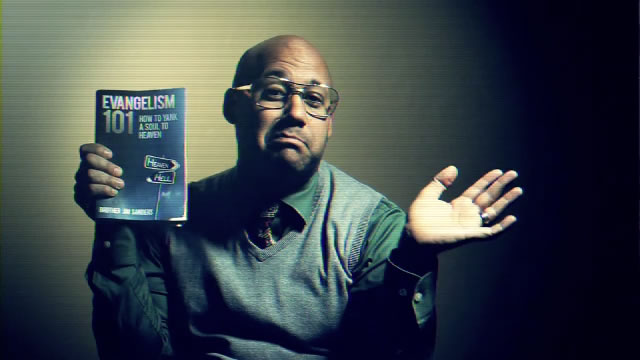
Evangelism Is Not…

The_Skinny_On_Evangelism_Skit_GuysThis last Sunday, my church began a mini teaching series called, Blueprint. In this series, we our hoping to equip our people with an understanding of who the church is, what we are supposed to be doing, and why we ought to be doing it. It should be a helpful and, by God’s grace, fruitful endeavor.

Last night, Pastor Derick Zeulner kicked off the series by preaching on the church’s task in evangelism. Far from being a guilt-ridden scolding, Pastor Derick helped us all see what evangelism is and invited us to become a church that is diligent in sharing the very good news about Jesus in our everyday, ordinary lives.

As I was thinking about the sermon, I recalled a very helpful chapter from my favorite book on evangelism, The Gospel & Personal Evangelism by Mark Dever. The chapter was titled, “What Evangelism Isn’t.” As you can guess, the chapter went through various things people often mistake for evangelism. For your edification, I offer them, along with mini-excerpts, below…

Evangelism Is Not Apologetics. “Apologetics is defending the faith, answering the questions others have about Christianity. It is responding to the agenda that others set. Evangelism, however, is following Christ’s agenda, the news about him. Evangelism is the positive act of telling the good news about Jesus Christ and the way of salvation through him.”

Evangelism Is Not Imposition. “It’s important to understand that the message you are sharing is not merely an opinion but a fact. That’s why sharing the gospel can’t be called an imposition, any more than a pilot can impose his belief on all his passengers that the runway is here and not there.”

Evangelism Is Not Social Justice. “Being involved in mercy ministries may help to commend the gospel, which is why Jesus taught, “Let your light shine before men, that they may see your good deeds and praise your Father in heaven” (Matt. 5:16). Displaying God’s compassion and kindness by our actions is a good and appropriate thing for Christians to do. But such actions are not evangelism. They commend the gospel, but they share it with no one. To be evangelism, the gospel must be clearly communicated, whether in written or oral form.”

Evangelism Is Not Your Testimony. “One of the classic testimonies was given by a blind man Jesus healed. When he was questioned after Jesus healed him, he responded, “Whether he [Jesus] is a sinner or not, I don’t know. One thing I do know. I was blind but now I see!” (John 9:25). The man disregarded the menacing threats of those more honored and respected than he in order to give this verbal witness to the power of God. It’s a wonderful, powerful testimony, but it’s not evangelism. There is no gospel in it. The man didn’t even know who Jesus was…An account of a changed life is wonderful and inspiring thing, but it’s the gospel of Jesus Christ that explains what it’s all about and how it happened.”

Evangelism Is Not The Results of Evangelism. “The Christian call to evangelism is a call not simply to persuade people to make decisions but rather to proclaim to them the good news of salvation in Christ, to call them to repentance, and to give God the glory for regeneration and conversion. We don’t fail in our evangelism if we faithfully tell the gospel to someone who is not converted; we fail only if we don’t faithfully tell the gospel at all. Evangelism itself isn’t converting people; it’s telling them that they need to be converted and telling them how they can be.” (This is taken from The Gospel and Personal Evangelism, p. 69-82. For a short video promo on the book, click here. Also, you can read the whole chapter for free here.)

So, if these things aren’t evangelism, then what is? Well, since Dever started this mess, I will let him answer that question. On his ministry’s website (9Marks), he explains evangelism as follows:

Evangelism is telling others the good news about what Jesus Christ has done to save sinners.

In order to do this you must tell others that:

  1. God is holy (1 Jn. 1:5). He is the creator of all things (Gen. 1:1).
  2. All people are sinners who deserve God’s righteous, eternal wrath (Rom. 3:10-19, Mark 9:48, Rev. 14:11).
  3. Jesus Christ, who is fully God and fully man, lived a sinless life, died on the cross to bear God’s wrath in the place of all who would believe in him, and rose from the grave in order to give his people eternal life (John 1:1, 1 Tim. 2:5, Heb. 7:26, Rom. 3:21-26, 2 Cor. 5:21, 1 Cor. 15:20-22).
  4. The only way to be saved from eternal punishment and be reconciled to God is to repent of sin and trust in Jesus Christ for salvation (Mark 1:15, Acts 20:21).

Evangelism is telling others this basic message.


Posted in Uncategorized | Tagged , , | Leave a comment

God Has Camped in Our Backyard

GameChangers

“No one has ever seen God; the only Son, who is in the bosom of the Father, he has made him known.” John 1:18

In preaching on this verse, John Piper made these comments that have continually blessed me ever since I read them:

God came to live in a tent so we can watch him more closely. God wants to be seen and known in his Son.

The same point is made in verse 18. “No one has ever seen God; the only Son…who is in the bosom [in the lap or the embrace] of the Father, he has made him known.” Here the point is that even though God is a Spirit and is therefore invisible (John 4:24), he has now revealed himself in an utterly unique way—by the incarnation of himself in his Son Jesus. In Jesus we see God.

You don’t have to wonder today if there is a baby in the womb of a woman eight weeks pregnant. And you don’t have to wonder what it’s like. We have pictures and videos and models and detailed physiological descriptions.

And so it is with God. You don’t need to be in the dark about God. He has gone beyond parchment and paper. He has gone beyond tapes and cassettes. He has gone beyond videos and even beyond live drama. He has actually come and pitched his tent in our backyard and beckoned us to watch him and get to know him in the person of his Son Jesus. When you watch Jesus in action, you watch God in action. When you hear Jesus teach, you hear God teach. When you come to know what Jesus is like, you know what God is like. (Taken from a marvelous sermon titled, The Word Became Flesh)

Amen. Amen. Amen.

Posted in Uncategorized | Tagged , , | Leave a comment

The Saturday Post(s)

Saturday Post

A Lustful Man Doesn’t Want a Woman. I appreciate Lewis’ comments on  what a lustful really wants and how that isn’t a woman.

How to (And Not to) Minister to Families Battling Cancer. “Reflecting on our past and present experience with cancer, we have been blessed to have family, friends and a church family who have been wonderfully supportive. Quite often, people want to know how they can help and encourage someone going through the experience of cancer or other medical related trials. I hope that you will find this list useful as you minister to others.”

Apologetic Arguments Can Reshape Our Culture’s Plausibility Structures. “Whether [apologetic arguments] are directly useful in leading unbelievers to Christ, they can be indirectly useful in reshaping the plausibility structures of our culture.”

Seven Different Ways to Read Books. This is actually very helpful. “When it comes to reading, well, you’ve got to use the right tool—you’ve got to know what kind of reading to do. Here are seven different kinds of reading.”

Through Heaven’s Doorway. A very encouraging post about death.

Five Things to Avoid When You Are Weak. “Here are five impulses to resist when you feel like you’re not good enough…”

Is the Gospel More Like a Newspaper or To-Do List? One of my middle school interns, Noah Gjertsen-Illig, produces another great post.

Squirrel Man. James Russell donned a wingsuit and a camera last week for this incredible flight along the side of a cliff, straight through a waterfall in Switzerland…

Posted in Uncategorized | Tagged , , , , , , , , , | Leave a comment

God Above, Against, and With Us

11295“The virgin will conceive and give birth to a son, and they will call him Immanuel” (which means “God with us”). Matthew 1:23

In commenting on this verse, Matthew Henry offers this little treasure:

Behold, in this, the deepest mystery, and the richest mercy, that ever was.

By the light of nature, we see God as a God above us;

by the light of the law, we see him as a God against us;

but by the light of the gospel, we see him as Immanuel, God with us, in our own nature, and (which is more) in our interest.

I have said it before, and I shall say it again, if you haven’t read Matthew Henry’s commentary on the whole Bible, do it. Access it all free here. Look up your favorite verse and read his comments on it. I am almost 100% sure you will be blessed.

Posted in Uncategorized | Tagged , , , , | Leave a comment

Why Love the Church?

No Rambo Christianity

No Rambo Christianity

We, in the West, live in an individualistic society. There really is no arguing it. I don’t think any westerner would even try. We love our families, yes. We are grateful for our friends and even our communities, but when it comes to thinking about ourselves and our lives, they really aren’t a factor. Though we benefit from our communities, they rarely have anything to do with our identity. We are a people more readily characterized by the spirit of Rambo, Jason Bourne, and Jack Bauer. We need no army or help. We bow to none.

This spirit has seeped into the church as well. Many Christians view their Christianity with the same individualistic lenses. Community, for them, is an option to benefit from when convenient, but not an obligation, responsibility, or requirement.

But this is terribly unbiblical. In fact, it is un-Christlike.

You cannot be an obedient follower of Jesus Christ and be ambivalent or neglectful of the church. How is this so? To put it simply, because Jesus loves the church and deems her existence and well-being as something of the utmost importance. To say it simply, if Christ is important to you, then the church will be as well. As always, Mark Dever nails it:

Ultimately, the church should be regarded as important to Christians because of its importance to Christ. Christ founded the church (Matthew 16:18), purchased it with His blood (Acts 20:28), and intimately identifies Himself with it (Acts 9:4). The church is the body of Christ (Ephesians 1:23; 4:12; 5:23-32; Colossians 1:18, 24; 3:15; 1 Corinthians 12:12-27), the dwelling place of His Spirit (Romans 8:9, 11, 16; 1 Corinthians 3:16-17; 6:11, 15-17; Ephesians 2:18, 22; 4:4), and the chief instrument for glorifying God in the world. Finally, the church is God’s instrument for bringing both the Gospel to the nations and a great host of redeemed humanity to Himself (Revelation 5:9). (Taken from the article entitled, The Church: A Display of God’s Glory)

If Christ is important to you, then the church will be also. His love will become your love. What captures His attention will also capture yours. If Christ is of any value to you, then the church will be as well.

Posted in Uncategorized | Tagged , , | 4 Comments

God’s Credit Card

Credit-cardsBeing a youth pastor offers me a front row seat to watch young saints be exposed to the Word of God for the first time. I get to see their amazement at its truths. I get to rejoice in their thankfulness for its message. I get to meet with them in their confusion about its content. It truly is a glorious job.

Among the points of confusion, I have found one that almost every new Christian struggles with: the purpose of the Old Testament sacrifices. They know, through the gospel teaching they have heard and believed, that Jesus Christ is the only one who can do away with their sin. They know that Jesus alone has paid the penalty for sin (1 Peter 3:18) and that people can only be saved by putting their confidence in Him and His work for us on the cross (see John 3:16-17; Romans 3:21-26). Knowing this, they have a hard time wrapping their minds around the sacrifices offered for sins in the Old Testament. Essentially, they ask, “If Jesus is the only one who can atone for our sins, then what was going on with all those bloody sacrifices in the Old Testament? What place do they have? What purpose do they serve? What did they actually do?”

Among the many good answers to that question (e.g. they prepare God’s people for Christ, they show the seriousness of sin and need for blood atonement, they offer some tangible expression of atonement), there is one illustration I find immensely helpful especially when talking about the relationship between the forgiveness received by the Old Testament sacrifices and the final forgiveness offered in the blood of Christ, the ultimate Sacrifice. Bruce Ware explains it well:

Suppose you are in the mall, and you find some shoes you like. You can take those shoes up to the register, charge them to your credit card, and walk out of that store with your new shoes, having paid absolutely nothing for them! Why is this not shoplifting? Why are you not stopped at the door by the security guard and charged with stealing? You are free to leave with the shoes because you have entered a legal transaction whereby you have obligated yourself to a future payment by which you (and others) may now consider those shoes as your own. Even though you have not yet paid a penny for them, you have tied yourself legally to an agreement…by which those shoes will be paid for by you at some agreed upon date in the future. So, while the shoes are legally yours, they are only paid for when the credit card statement comes and a payment is made from your bank account.

In a similar way, God forgave the sin of all Old Testament saints, as it were, on credit. He devised a system of sacrifices by which each of those animal sacrifices would signal his obligation, at some point in the future, to ensure that the payment for those sins would surely and truly be made. In other words, in order to forgive those Old Testament saints at that point in history, he had to put in place a plan by which their sin, pronounced forgiven by him then, would one future day actually and fully be paid for. Apart form that future payment, those animal sacrifices were totally useless. (Taken from The Man Christ Jesus, p. 120-121)

Old Testament sacrifices were forgiveness on credit. They didn’t actually pay for anything. They never atoned for one, single sin. Lamb’s blood cannot make up for Man’s sin (see Hebrews 10:3-4). But those sacrifices pointed forward to the day when God would finally pay for all sin. They looked forward to when God would bring the sin balance to zero.

As Paul taught, “God presented Christ as a sacrifice of atonement,through the shedding of his blood—to be received by faith…” (Romans 3:25). Why did he do this? Paul explains, “He did this to demonstrate his righteousness, because in his forbearance he had left the sins committed beforehand unpunished — he did it to demonstrate his righteousness at the present time, so as to be just and the one who justifies those who have faith in Jesus…” (Romans 3:25-26). Did you see that? God offered Jesus as the sacrifice for sin in order to demonstrate his righteousness in the face of all the sins that were formerly unpunished! He put those sins on the credit card of the sacrificial system and, through offering Jesus Christ, paid it all off!

Praise God that our debt has been paid; interest and all.

Posted in Uncategorized | Tagged , , , , , , | 1 Comment

An Idol is Anything You Can’t Live Without

idolatry_by_fullofeyes-d4ytr58A few days ago, Pastor J.D. Greer wrote a piece where he gave five insights on idolatry from Acts 19. I found the piece very concise, simple, and profoundly helpful. I highly recommend you read the entire post. I promise you won’t regret it.

To whet your appetite and grease your gears for the task, I thought the first insight was especially helpful and heart-searching as he answers the question, “What is an idol?”

An idol is anything that promises a life of security and joy apart from God.

In Acts 19, Artemis is described as the “protector” and “prosperer” of Ephesus. With her, the Ephesians believed, they were guaranteed security and joy. This false hope is precisely what makes an idol an idol. Idols are not usually bad things, but good things that have become ultimate things—things you believe guarantee you joy and security.

What is that in your life? About what do you think, “As long as I have this, I’ll have happy”? What do you so desperately need that you can’t imagine a fulfilled life without it?

What makes these idols so dangerous is that they are nearly always good things. I have seen the good of desiring marriage become a false god. I’ve seen the good of wanting to provide become the idol of always needing to achieve one more financial benchmark. The problem isn’t the money or the marriage. The problem comes when we trust in those things to satisfy.

When you think about idolatry, don’t think of making sacrifices to little action figurines in a smoke filled temple, but think about the things you are tempted to live for; the things you can’t live without. Think of your family, spouse, children, girlfriend, or boyfriend. Think about being praised and honored among your family, friends, peers, and community. Think about getting into a good college or having a successful career. Those are the things that we are tempted to live for; the good things that we tend to make the ultimate things. Those are the things we must enjoy, but never worship.

Amidst the calls of these idols, here God clearly, “You shall have no other gods before me” (Exodus 20:3). Amidst the call of these idols, may we too pray, “Turn my eyes from looking at worthless things; and give me life in your ways” (Psalm 119:37).

Posted in Uncategorized | Tagged , , | Leave a comment

The Saturday Post(s)

Saturday Post

Homosexuality in the Church. This is sure to be an excellent podcast series on a very important topic.

5 Insights Into Idolatry. Our middle school summer camp is on idolatry, so this caught my eye. “Most modern people don’t quite get the Bible’s obsession with idolatry. We think of idolatry as an ancient problem for backwards people who bowed down to statues, not a relevant one for sophisticated folks like us. But we aren’t beyond idolatry. We simply dress it up in different clothes.”

A Law Professor’s Three Predictions About the Future of Religious Liberty. I think I agree with this fellow. Justin Taylor’s preface is also spot on,  “The piece is very well-written, but be forewarned that it is not encouraging…”

Does the Doctrine of Hell Make God Unjust? A thoughtful piece on a topic many like to be fuzzy about.

The Drinking, Hook-Up, and Sexual Assault Culture of College Campuses. One good example of how our allowance for what we deem small indiscretions usually lead to major offense. “Without the “hook-up culture,” the “rape culture” would not have gotten its current foothold in our universities…”

5 Prayers for the Unsaved in Your Life. “There are people all around you who need Jesus. He wants to use you to reach them. Here are some of the specific ways you too can pray for people the in your life who need Christ…”

Bananas. This man has just become my favorite baseball player.

Posted in Uncategorized | Tagged , , , , , , , | Leave a comment

Jesus is Bigger Than a Logging Truck

How-to-Stop-Running-Fruitless-Events_780x439-570x320Have you ever met someone who claims they are a Christian yet their life shows no evidence? The only thing that points to the Christianity is their bare claim. People who, “claim to know God, but by their actions they deny him” (Titus 1:16)?

In no uncertain terms, the Bible exposes this and calls it what it is: false conversion. Those whose lives are unaffected by the gospel of Jesus Christ prove that they do not know Jesus Christ. They may claim to know Him, but, as John says, they are liars and the truth is not in them (1 John 2:4).

How can I say this? Because Jesus does:

Beware of false prophets, who come to you in sheep’s clothing but inwardly are ravenous wolves. You will recognize them by their fruits. Are grapes gathered from thorn bushes, or figs from thistles? So, every healthy tree bears good fruit, but the diseased tree bears bad fruit. A healthy tree cannot bear bad fruit, nor can a diseased tree bear good fruit. Every tree that does not bear good fruit is cut down and thrown into the fire. Thus you will recognize them by their fruits. (Matthew 7:15-20)

The truth is, the salvation that Jesus offers is not just something done for you, it is something done to you. Being saved by Jesus Christ means being made into an entirely new creation (2 Corinthians 5:17) and being made a new creation will make an observable difference in everything you say, think, desire and do. If you become a Christian, it will show. In illustrating this truth, Paul Washer brings it home.

Let’s imagine that I show up late and I run up here on the platform, and all the leaders are angry with me and say, “Brother Paul, don’t you appreciate the fact you’re given an opportunity to speak here and you come late?”

And I’d say, “Brothers, you have to forgive me.”

“Well, why?”

“Well, I was out here on the highway, and I was driving and I had a flat tire and I got out to change the tire, and when I was changing the tire, the lug nut fell off, and I wasn’t paying attention that I was on the highway and I ran out and I grabbed the lug nut, and as soon as I picked it up in the middle of the highway, I stood up and there was a 30-ton logging truck going 120 miles an hour about ten yards in front of me, and it ran me over and that’s why I’m late.”

Now, there would only be two logical conclusions. One, I’m a liar or, two, I’m a madman. You would say, “Brother Paul, it’s absolutely absurd. It is impossible, Brother Paul, to have an encounter with something as large as a logging truck and not be changed.” And then my question would be to you–What is larger? A logging truck or God?

How is it that so many people today profess to have had an encounter with Jesus Christ, and, yet, they are not permanently changed? Let me give you a few things to think about. How many times do you go and rededicate your life over and over and over again? How many times do youth groups go to things like this and get fired up and go back to the church, and it lasts about a week and a half? And yet, “Oh, it was a great move of God.” No, it wasn’t. If it doesn’t last, it wasn’t a great move of God. It was emotion. It was so many things, but it wasn’t a great move of God.

You will know them by their fruit.

You will know them by their fruit. (Taken from this sermon)

To sum it up, Jesus is bigger than a semi-truck. Meeting Him will change you and others will notice. A Christianity that doesn’t change you is a Christianity with no Christ. If you haven’t been changed by Jesus then you haven’t been saved by Jesus, but take heart, His offer still stands today. Read of it here.


Posted in Uncategorized | Tagged , , , , , | Leave a comment

Genesis One If God Were Not All Powerful

Unknown-2This summer, I and my ragtag crew are teaching the middle schoolers of our church the theology of The Apostles’ Creed. Yesterday, I preached at on the phrase of the Apostles’ Creed that calls God the Father, the Maker of Heaven and Earth. As I spoke about the familiar scenes of Genesis one, I found John Ortberg’s thoughts helpful. He invites us to imagine what Genesis one would look like if God were not as powerful as He actually is:

In the beginning, it was nine o’clock, so God had to go to work.  Imagine, you open your Bible, Genesis:  In the beginning, it was nine o’clock, so God had to go to work.  He filled out a requisition to separate the light from the darkness.  He considered making stars to beautify the night, but that sounded like too much work.  And besides, thought God, that’s not my job.  So, he decided to knock off early and call it a day.  He looked at what he had done and God said, “It’ll have to do.”  And on the second day, God separated the waters from the dry land, and he made all the dry land flat, and plain, and functional, so that behold!  The whole earth looked like Prineville.  And he thought about making mountains and valleys and glaciers and jungles and forests and waterfalls, but he decided it wouldn’t be worth the effort, and God looked at what he had done that day and said, “It’ll have to do.”  And God made a pigeon to fly in the air and a carp to swim in the waters and a cat to creep on the dry ground.  And God thought about making millions of other species of all sizes and all shapes and all colors but he couldn’t drum up any enthusiasm for any other animals, and in fact he wasn’t too crazy about the cat.  And besides, it was almost time for Letterman.  And God looked at all his hand had done and God said, “It’ll have to do.”  And at the end of the week, God was seriously burned out.  And so he breathed a big sigh of relief and said, “Ah, thank Me, it’s Friday!’ (Taken from The Life You’ve Always Wanted: Spiritual Disciplines for Ordinary People)

May we never let God’s amazing power lead us to yawn. If it does, we can rest assured that the problem is not with Him, but us.

Posted in Uncategorized | Tagged , , , , | Leave a comment