

When you meet a hardship in life, it is helpful to know you have three options.
You Can Stop
Quitting is always an option and it isn’t always a bad one either. If the pain or harm of something isn’t worth the goal, why go on? If the quick pleasure of smoking cigarettes isn’t worth long term health, then kick the habit. When eating ice cream every night is getting you close to diabetes, stopping is wise. If your habit of reading emails at home is costing your family time, then quit. Wise folks know when to quit.
However, if the goal is worth the pain, it’s wise to stay the course. Overall health is a worthy enough goal to pay the cost of sore muscles and fewer In & Out burgers. Learning is valuable enough to sacrifice time, energy, and attention for. A healthy friendship is valuable enough to walk through the pain of conflict and forgiveness.. The place of good is only reached by the road of hard. If the good is good enough, the road is worth sticking to.
The more important something is, not only does it merit the hardships involved in attaining it, the more dangerous quitting becomes. If your boss is cantankerous and mean, quitting your job, especially when you’ve no other to replace it with, will have significant consequences for your ability to pay bills. If your child has entered a season of rebellion and folly that breaks your heart, quitting on them will likely only widen the gates for even more pain and harm to enter through. If your spouse has frustrated or pained you for years, quitting the relationship won’t necessarily heal the pain. It may only metastasize it. For the most important things in life, perseverance is life and quitting is death.
There is a time to quit and a time to press on. To know the difference, ask, “Is the possible goal worth the present difficulty?” If it isn’t, leave it behind. If it is, press on.
You Can Stay
It is wild what we get used to. If we’ve endured a difficulty for long enough, it kind of becomes comfortable in a way. Though we may not prefer it, the passing years have made us familiar enough with it to tolerate it. So, where some people quit, some stay with no intention of changing anything. They don’t do anything about the problems they experience other than grumble about it occasionally or not so occasionally.
People do this with relationships frequently. This is the person who complains loudly about certain friends or family members; never to their faces, but behind their backs because they’re polite. In speaking about one friend they’ll point out why they’re inconsiderate, rude, hurtful, detached, self-interested, and the list goes on. If you listen intently and compassionately, you may innocently ask, “Man, that all sounds really hard. Have you spoken to them about these things? Can you think of ways to improve the relationship?” No, they answer. They haven’t and they won’t.
Now, it’s less common for people to flat out say they’re uninterested in doing anything about a bad relationship. It’s not a cute look. So, instead, they may dress up their inaction by more blaming, “They’re so selfish or arrogant, they’ll never listen.” Or they may frame themselves as the victim, “I have had to put up with too much and have tried too hard and I am too hurt. I am done with giving any more effort. I just try to be nice and endure it.” They may even get a little frustrated with you asking in the first place, “Why is it my responsibility? They’re the problem.” To their credit, they don’t quit their important relationships, but they don’t help them either.
The path of “Staying” is chosen by people who are miserable or unhappy about a thing and, while they’ve no intention of quitting it, they’ve no intention of changing it either. They decide to be a magnifying glass to their life’s least enjoyable elements.
Not recommended, folks.
You Can Seek
If something is too important to quit and too painful to just stay in, what is the third option? Seek to improve it. I’ve always loved Epictetus’ quip:
“Instead of meeting misfortune with groans and tears, I will call up the faculty especially provided to deal with it. ‘But my nose is running! What do you have hands for, idiot, if not to wipe your nose? ‘But how is it right that there be running noses in the first place?’ Instead of thinking up protests, wouldn’t it be easier just to wipe your nose?”
God has given us resources to faithfully bear and respond to the burdens we meet. He gives us wisdom, repentance, patience, prayer, community, discipline, forgiveness, and all sorts of other means by which we can seek to make hard things better. Will I use them or will I sit and complain through the boogers?
If work is overwhelming, you can complain about your boss or you can seek wisdom, ask for help, and develop better habits that make you and your work environment the best it can be. If you’re struggling financially, you can grumble about the cost of everything or you can seek counsel, make a budget, and learn to live within your means. If you’re struggling spiritually, you can lament how dry your faith feels or you can commit to hearty prayer, meditating on the Scriptures, seeking mature Christian counsel, confessing your sins, or building habits that help fix your eyes on Jesus. The hardship may not disappear overnight, but seeking gives you something stopping or staying never can: a way forward.
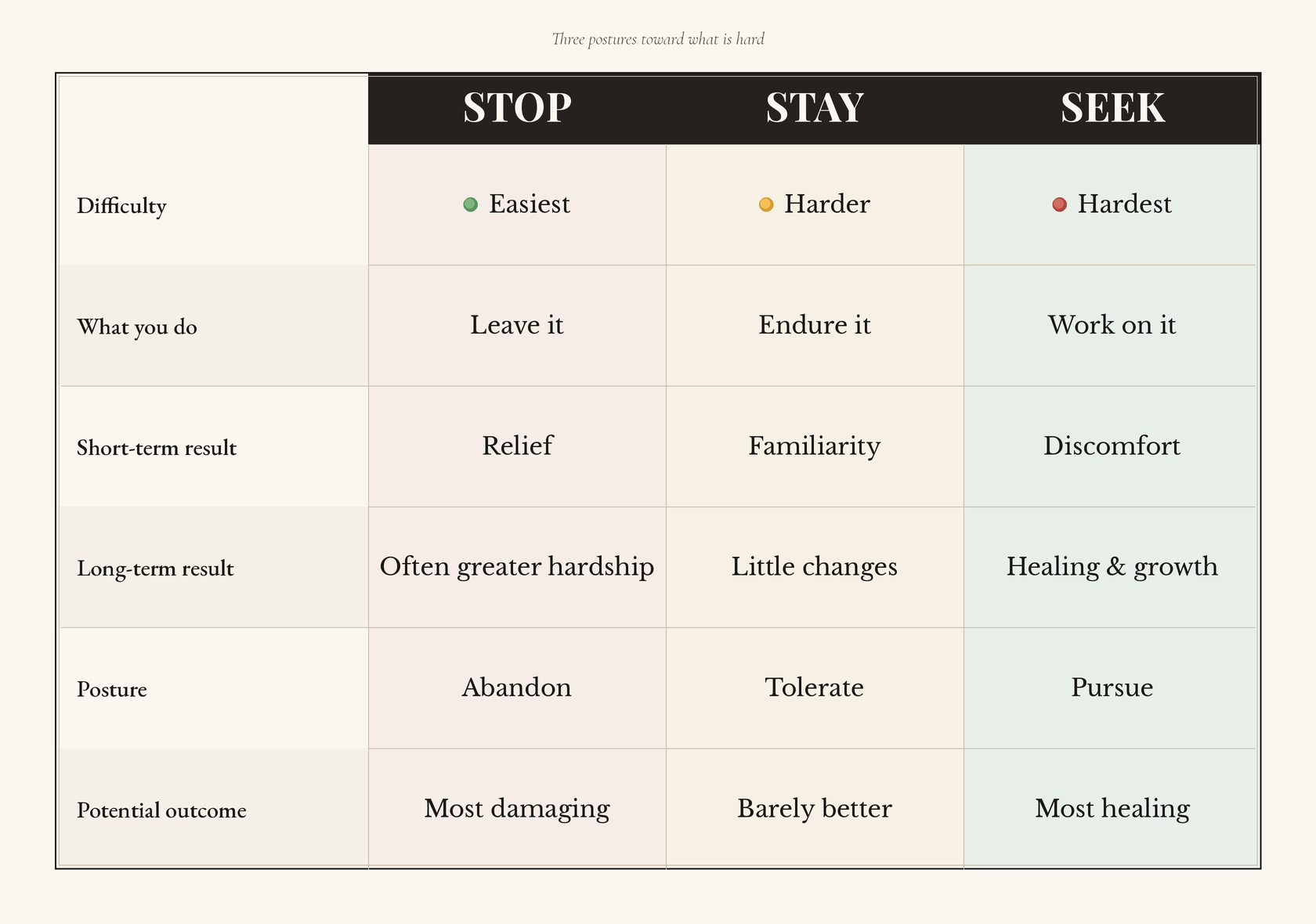
Sufferer, You Have Three Choices
When bad or hard things happen in life, you have three options: stop, stay, or seek. The first is easiest, but devastating when applied to important commitments. The second is a little harder, but the results aren’t much better. The third is the hardest. It requires humility, patience, perseverance, and a commitment not to feeling good, but doing good. But it also produces the best outcomes.
For the Christian, these three paths take on an even greater significance. Hardship is never merely something to escape or endure. Christ has not called us to the easiest path, but to the faithful one. He Himself walked the road of suffering, obedience, and sacrifice for our sake, and He promises to walk with us on ours. So when hardship comes, ask not merely, “How can I make this pain stop?” or “What do I feel like doing?” but, “What would be faithful?” The path of seeking Christ, His wisdom, His grace, and His transforming work will often be the hardest path, but it is the path that leads to the truest and best kind of life.
Seeking improvement is the only path that gives us the actual good that stopping and staying promise: long-term joy. Unwise quitters experience temporary relief that gives way to longer hardships. Stayers experience the weak comfort of self-righteous victimhood while wearing their pain every day. Seekers travel a long and difficult path toward actual good, healing, freedom, and joy.






Pingback: Cranky Grandpa Wisdom | A Pilgrim's Friend
Pingback: Cranky Grandpa Wisdom | A Pilgrim's Friend